Low MOQ Gummy Manufacturer

As a trusted custom gummy manufacturer, Nutreebio specializes in producing high-quality gummy supplements tailored to your brand’s needs. Whether you’re a startup looking for a low MOQ gummy partner, or an established company developing innovative health formulas, we provide flexible solutions, fast sampling, and full support from formulation to packaging. Our facility is equipped to manufacture gummies that meet global standards—vegan, non-GMO, sugar-free, halal, or custom fortified. Start building your private label today with one of China’s leading gummy manufacturers.

Our Classic Gummies Case

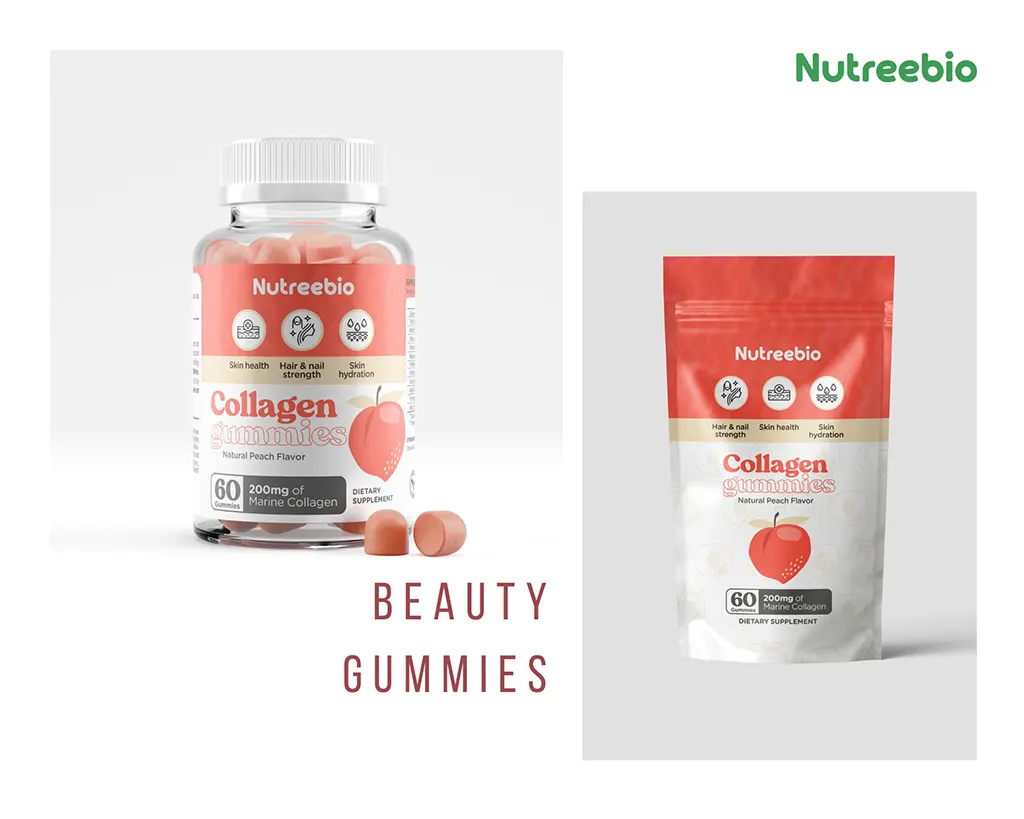
beauty gummies
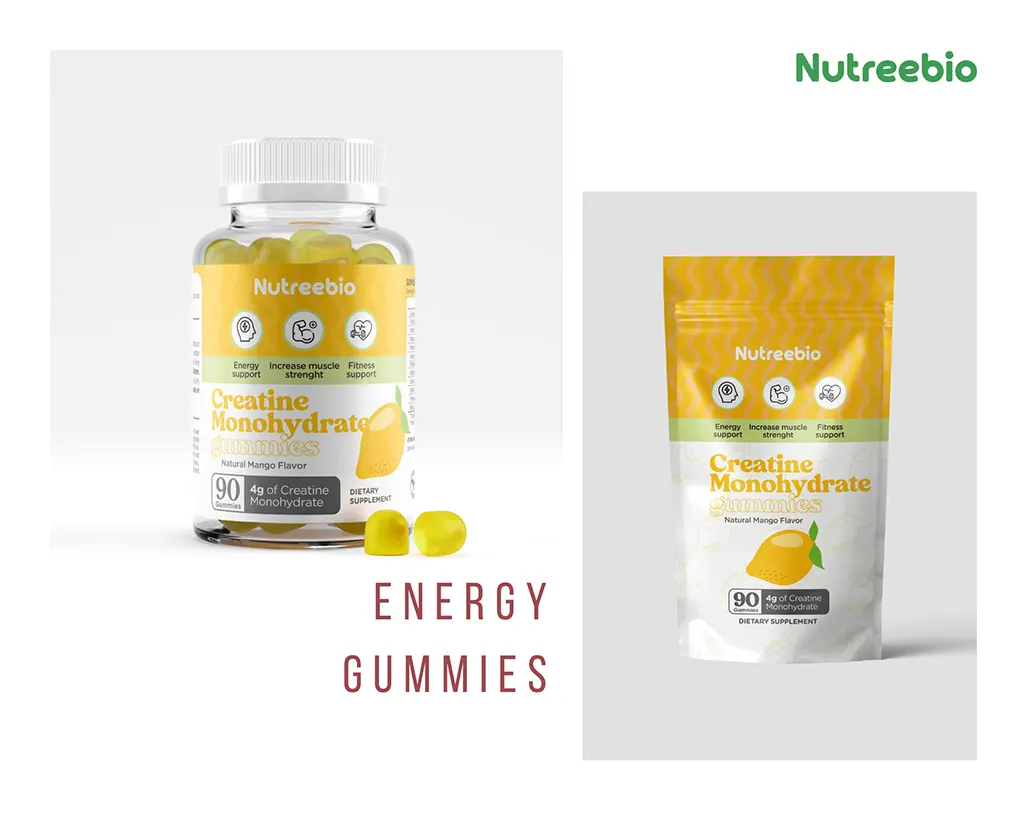
energy gummies
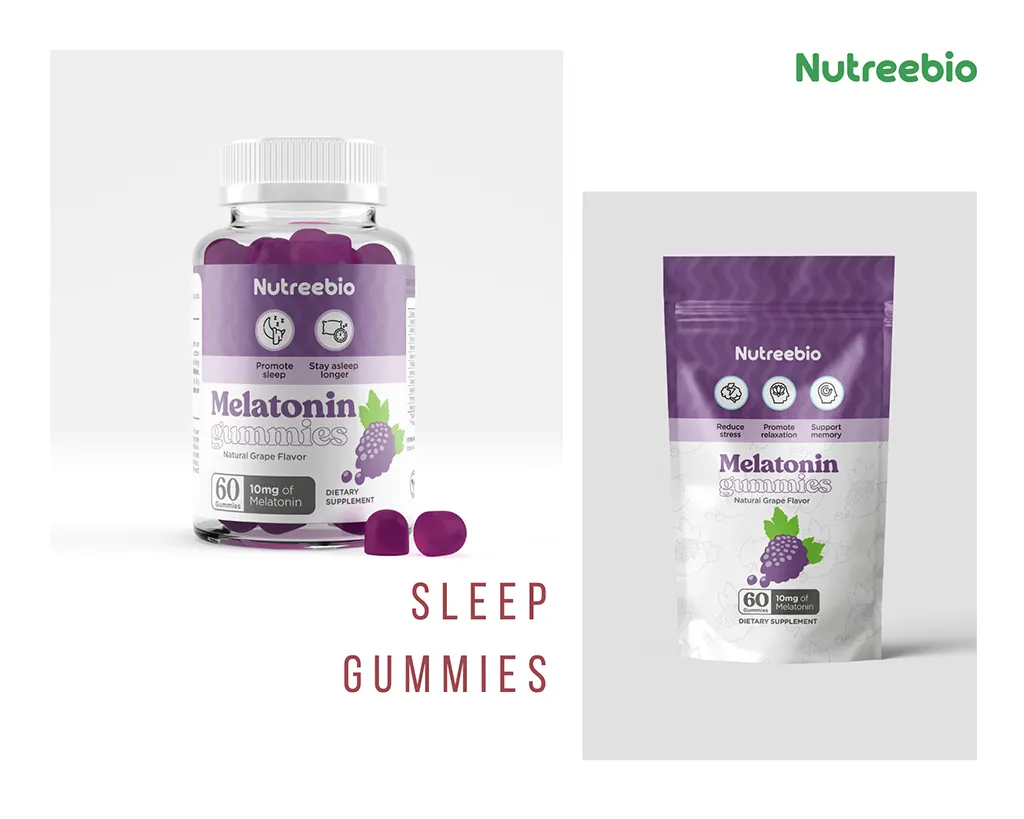
sleep gummies
private label packaging
For supplement brands

Low MOQ Gummy Manufacturing

Starting a gummy supplement project does not always require a very large first order. For many standard formulas and packaging formats, we can support low MOQ gummy manufacturing from around 2,000 bottles or pouches per SKU.

Suitable for startups and test launches

MOQ For Finished Products

2,000 bottles

MOQ For Bulk Gummies

500kg

What We Can Customize as a Gummy Manufacturer

As an experienced gummy manufacturer, Nutreebio offers more than just generic formulations—we provide full-spectrum customization tailored to your brand’s market, regulations, and innovation needs.

While we support customization of ingredients, flavors, labels, and packaging, here we focus on showcasing our in-house capabilities:

🧩 Gummy Shapes & Molds

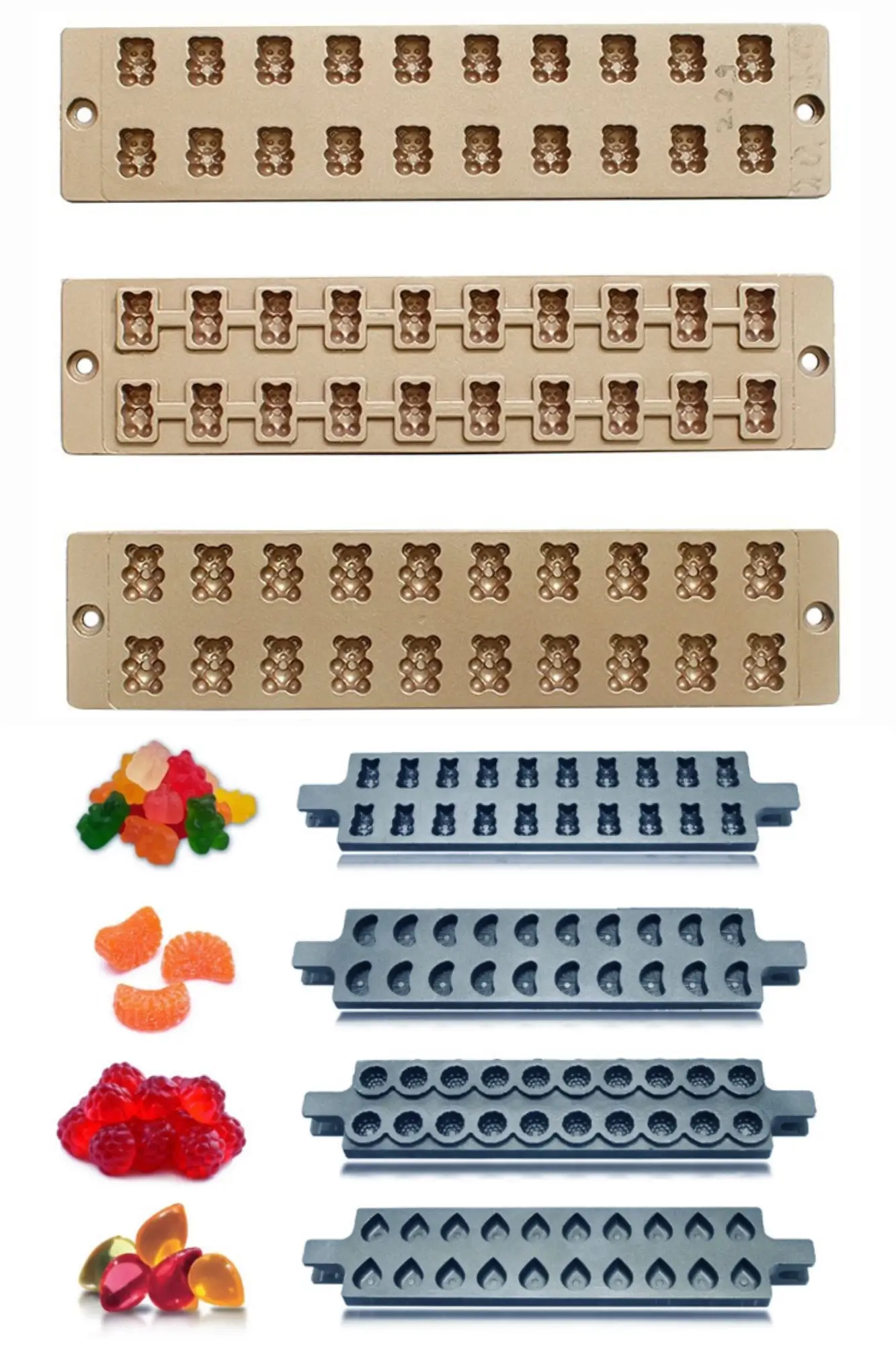
We have a wide range of ready-to-use gummy molds available in various shapes, including:

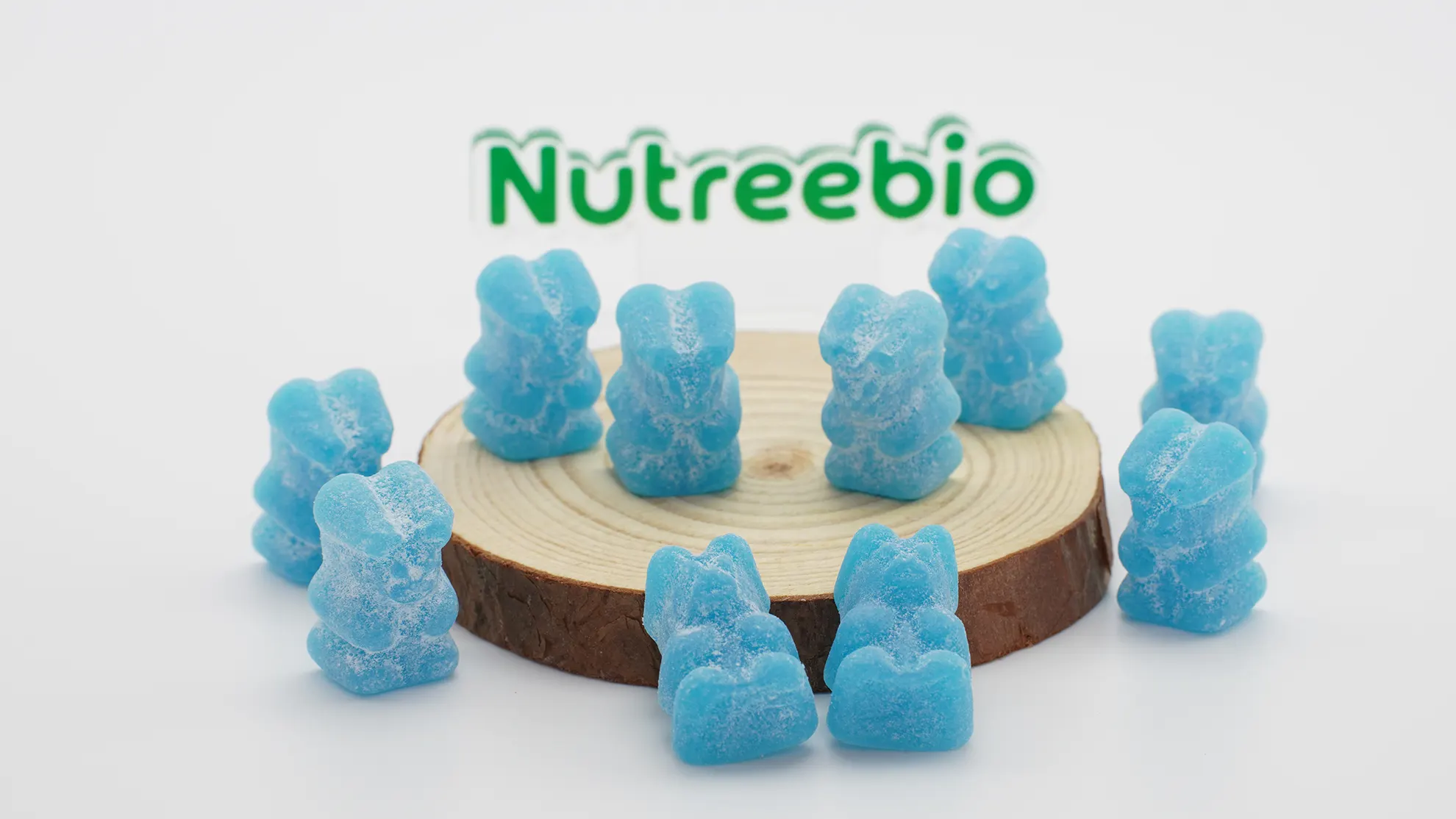
  • Bears, drops, hearts, rings, cubes, domes
  • Seasonal and novelty shapes (e.g., stars, animals)
  • Multi-cavity and multi-size mold options for flexible dosing

Our mold collection is constantly expanding to support low MOQ gummy customization without the need for expensive tooling.

Looking for trending formulations or market-ready gummies?
👉 Check out more Private Label Options here »

beige minimalist mood photo collage

📋 Factory Certifications

Nutreebio meets strict international manufacturing standards, ensuring compliance for markets like the US, EU, UK, and Australia.

We are certified by:

  • ✅ FDA-Registered Facility

  • ✅ BRC Global Food Safety

  • ✅ ISO 22000

  • ✅ GMP (Good Manufacturing Practice)

  • ✅ NSF (Dietary Supplements)

  • ✅ HACCP

These certifications allow you to confidently work with a custom gummy manufacturer that understands both regulatory compliance and brand trust.

未命名的设计

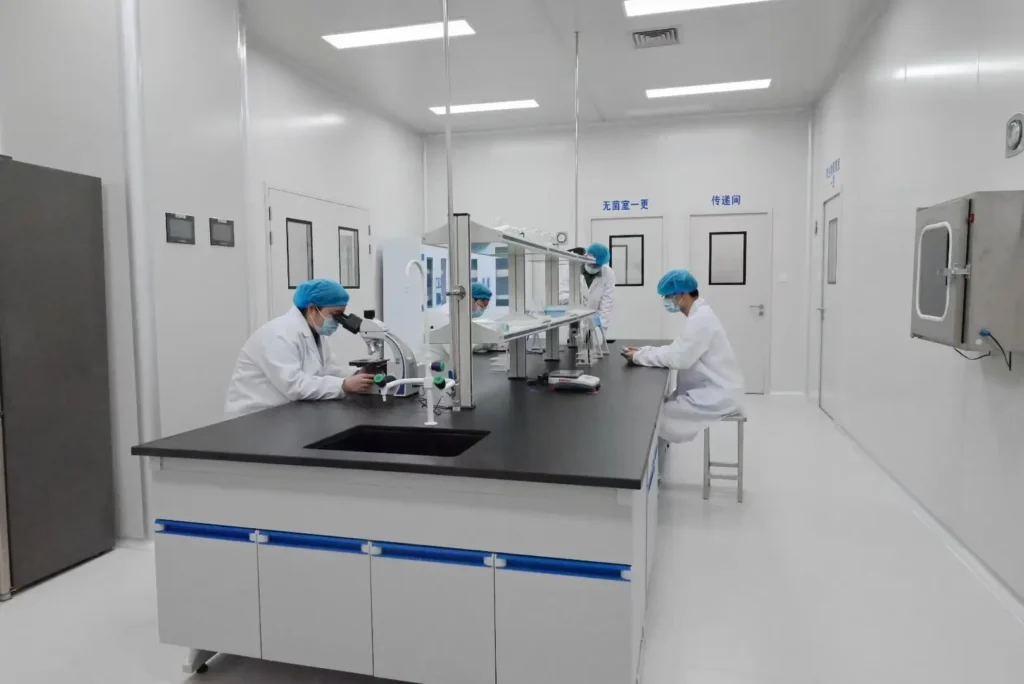
Certified Gummy Manufacturer with In-House R&D Lab

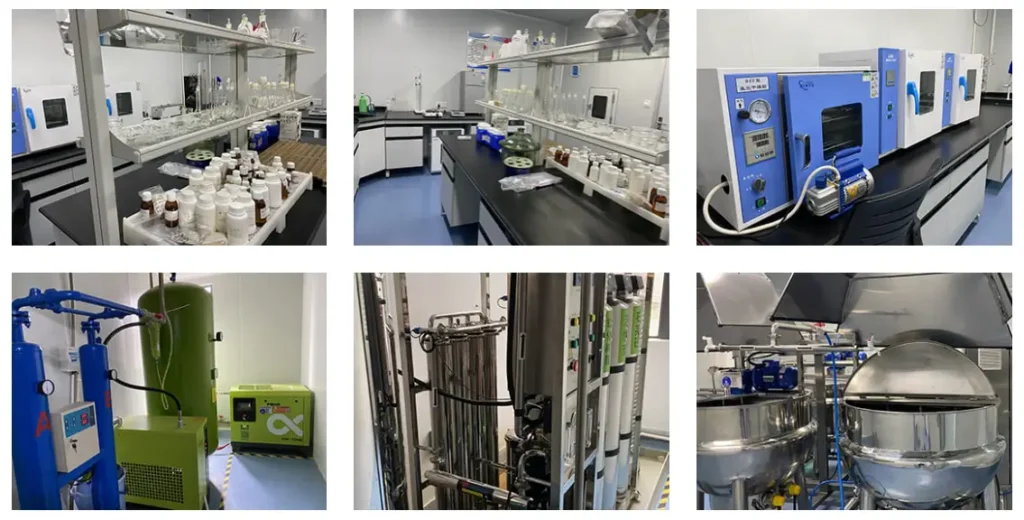
Our in-house laboratory ensures each formula is tested for accuracy, safety, and shelf stability before scaling to full production. Combined with FDA, GMP, and ISO certifications, our lab capability proves we’re more than just a packaging partner—we are a full-process manufacturer.

04
05

Every custom gummy formulation goes through a lab validation process—ingredient compatibility, flavor balance, pH stability, and texture testing—to ensure production feasibility and regulatory compliance.

additional quality testing

Gummy Customization Process with Lab Testing

gummies testing lab软糖打样实验室

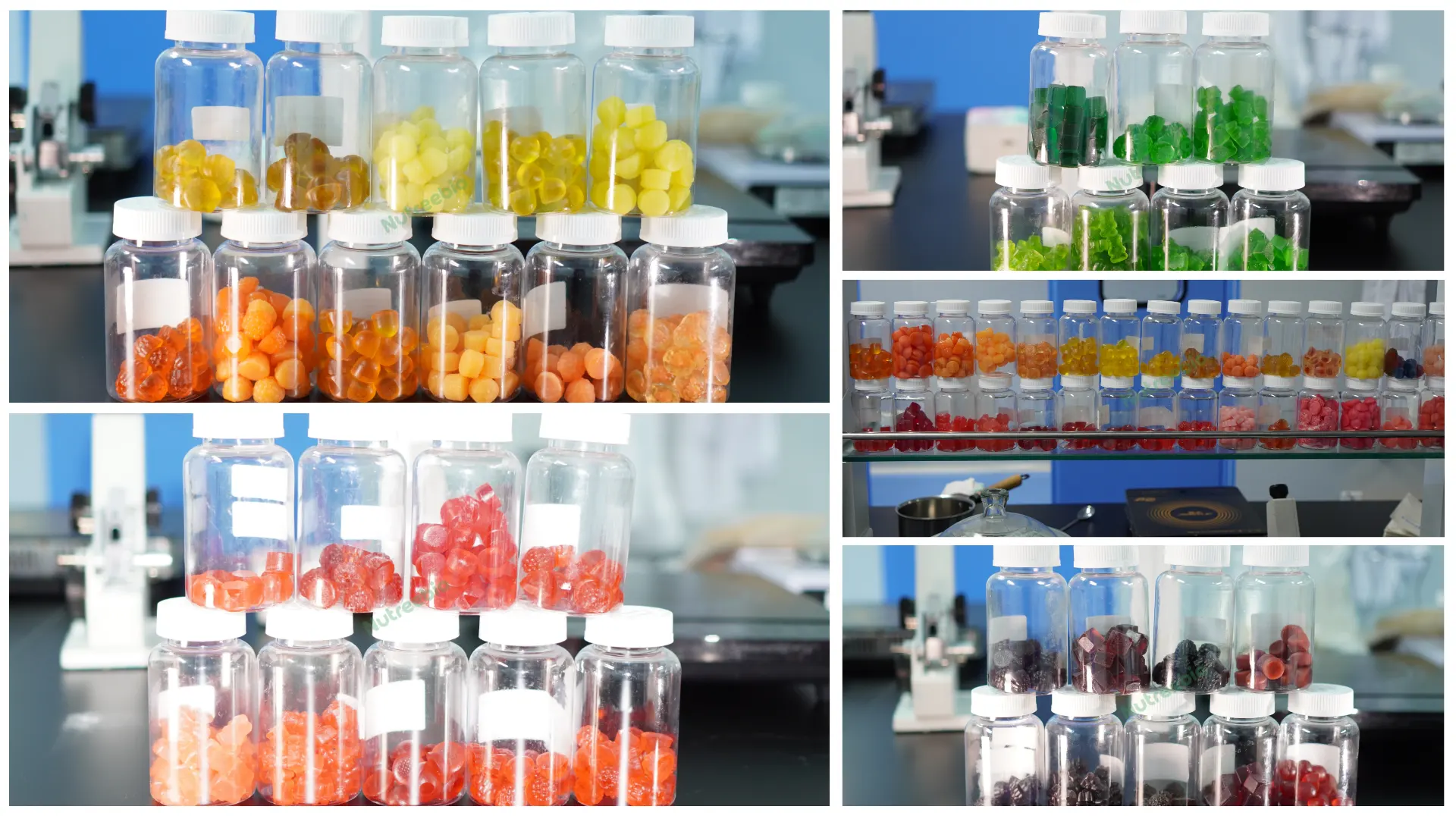
R&D Laboratory – From Concept to Gummies Samples

Our in-house R&D laboratory enables us to create and refine custom formulations with precision. From ingredient selection to pilot batches, we ensure each gummy sample meets both functional and taste expectations before moving into full-scale production.

R&D Laboratory Samples

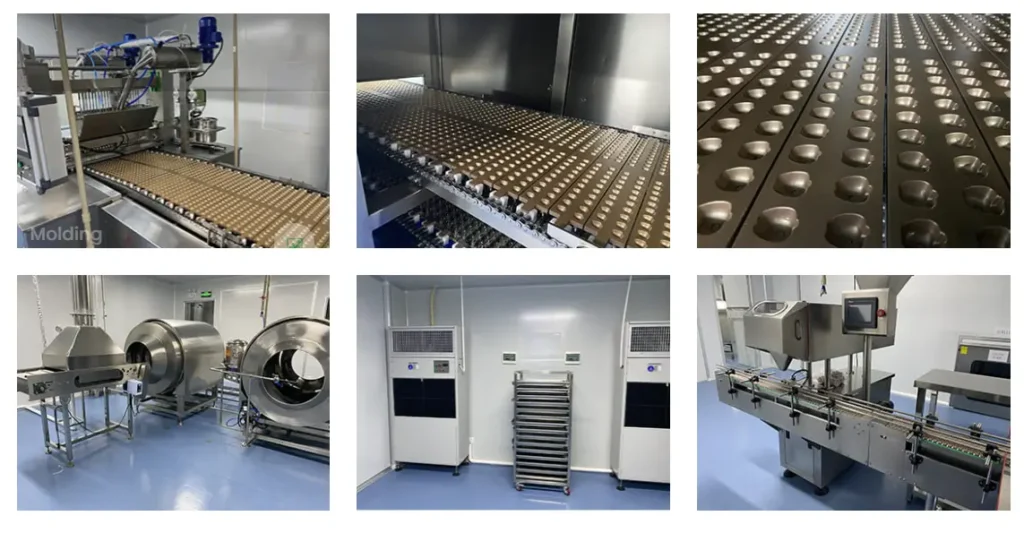
Gummies Manufacturing Process

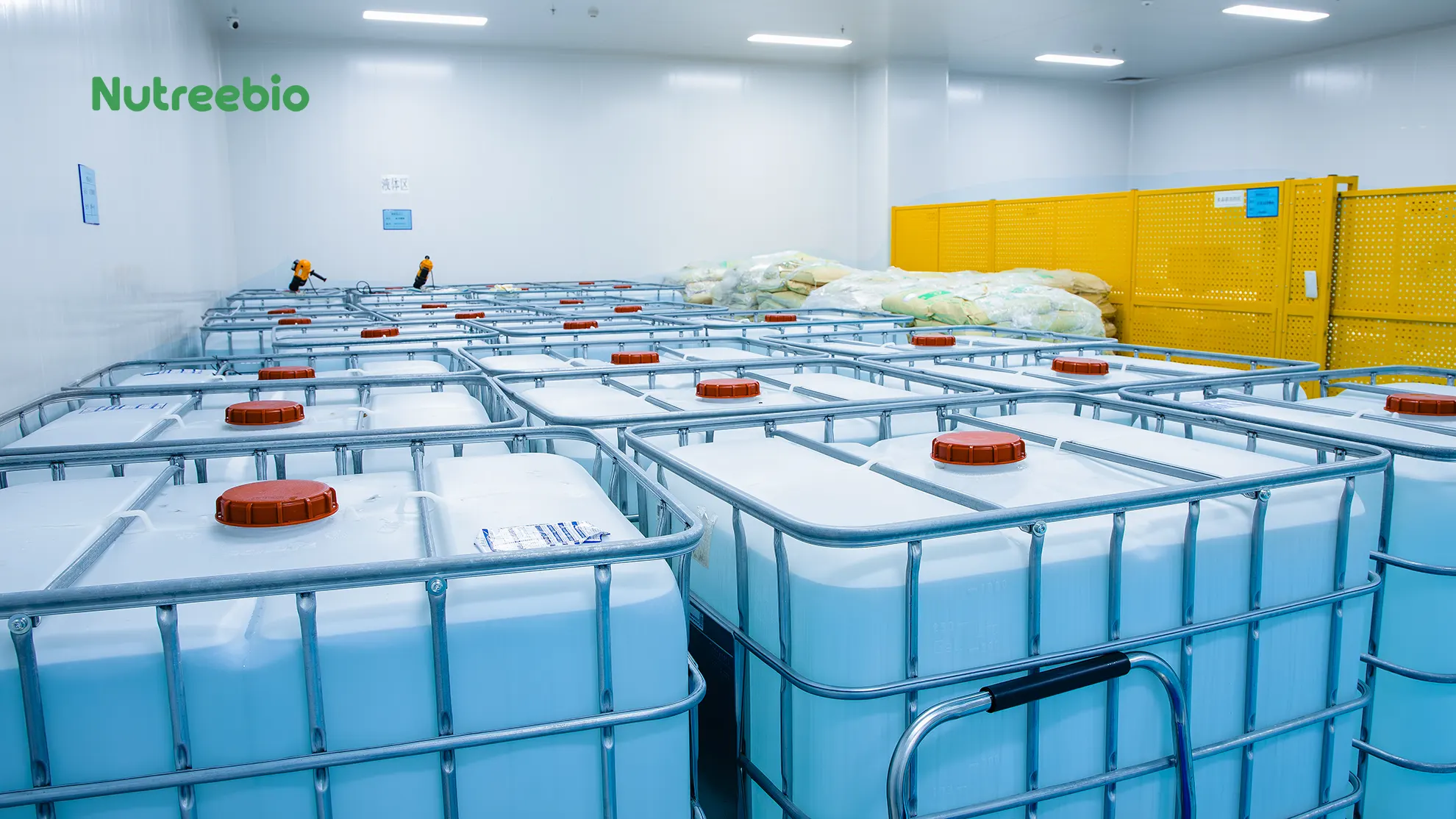
1. Raw Material Receiving & Inspection

Every batch of raw materials is sourced from trusted suppliers and undergoes thorough quality checks for purity, potency, and safety. These raw materials are then placed in our warehouse.

Raw Material Receiving & Inspection
Ingredients Cooking / Boiling

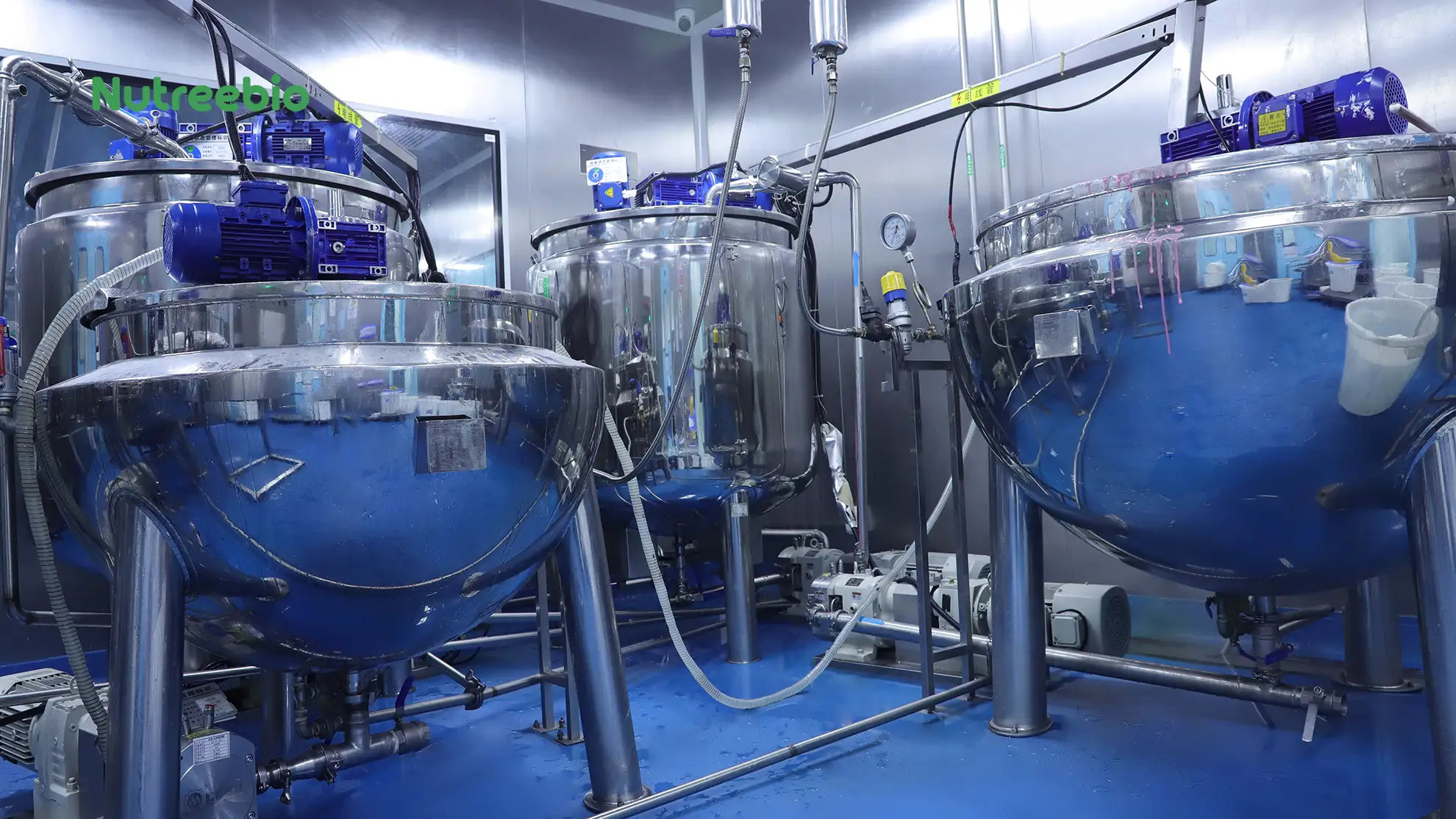
2. Cooking / Boiling

Ingredients are precisely measured and cooked under controlled temperature and timing to ensure optimal consistency and nutrient retention.

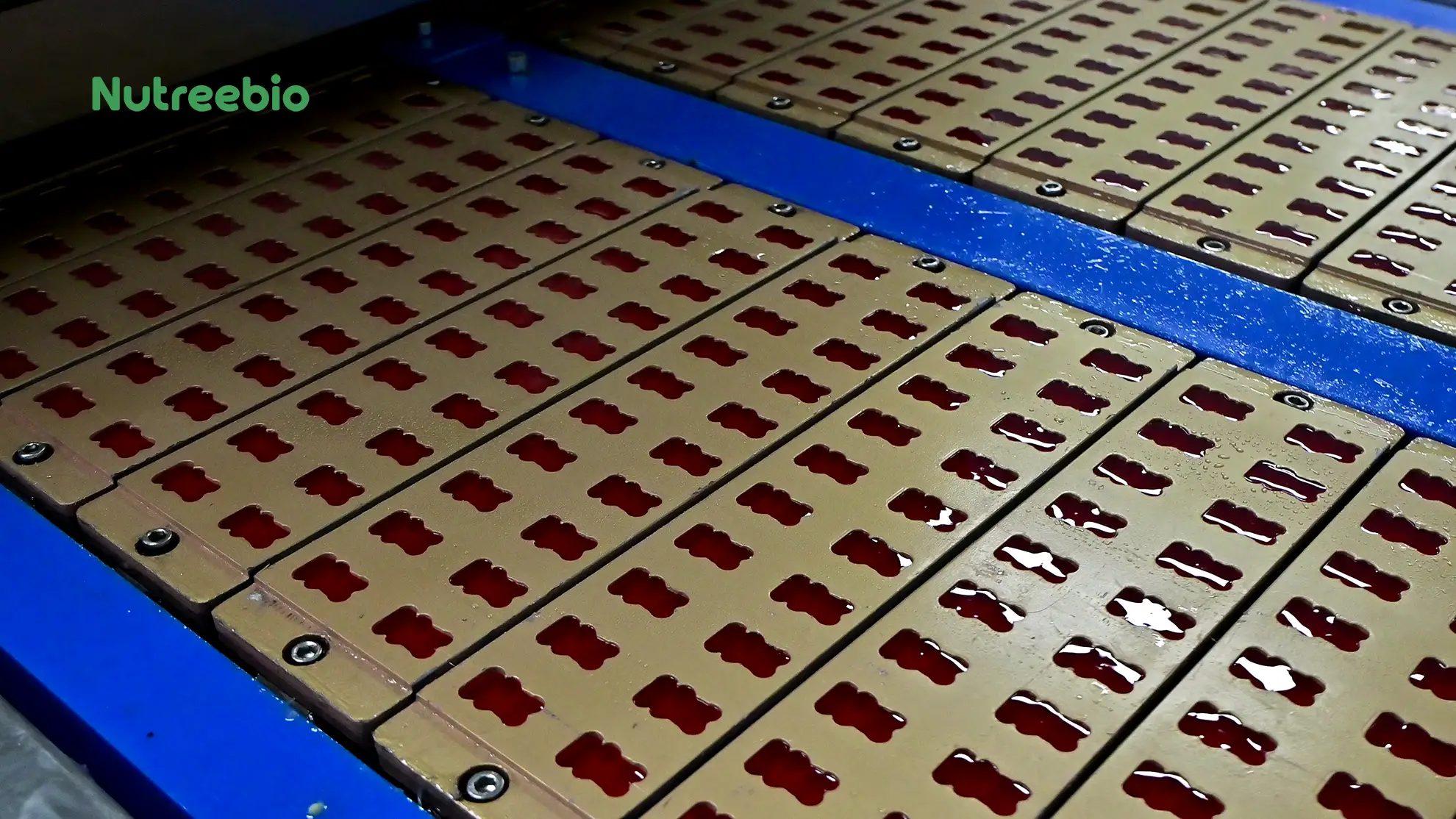
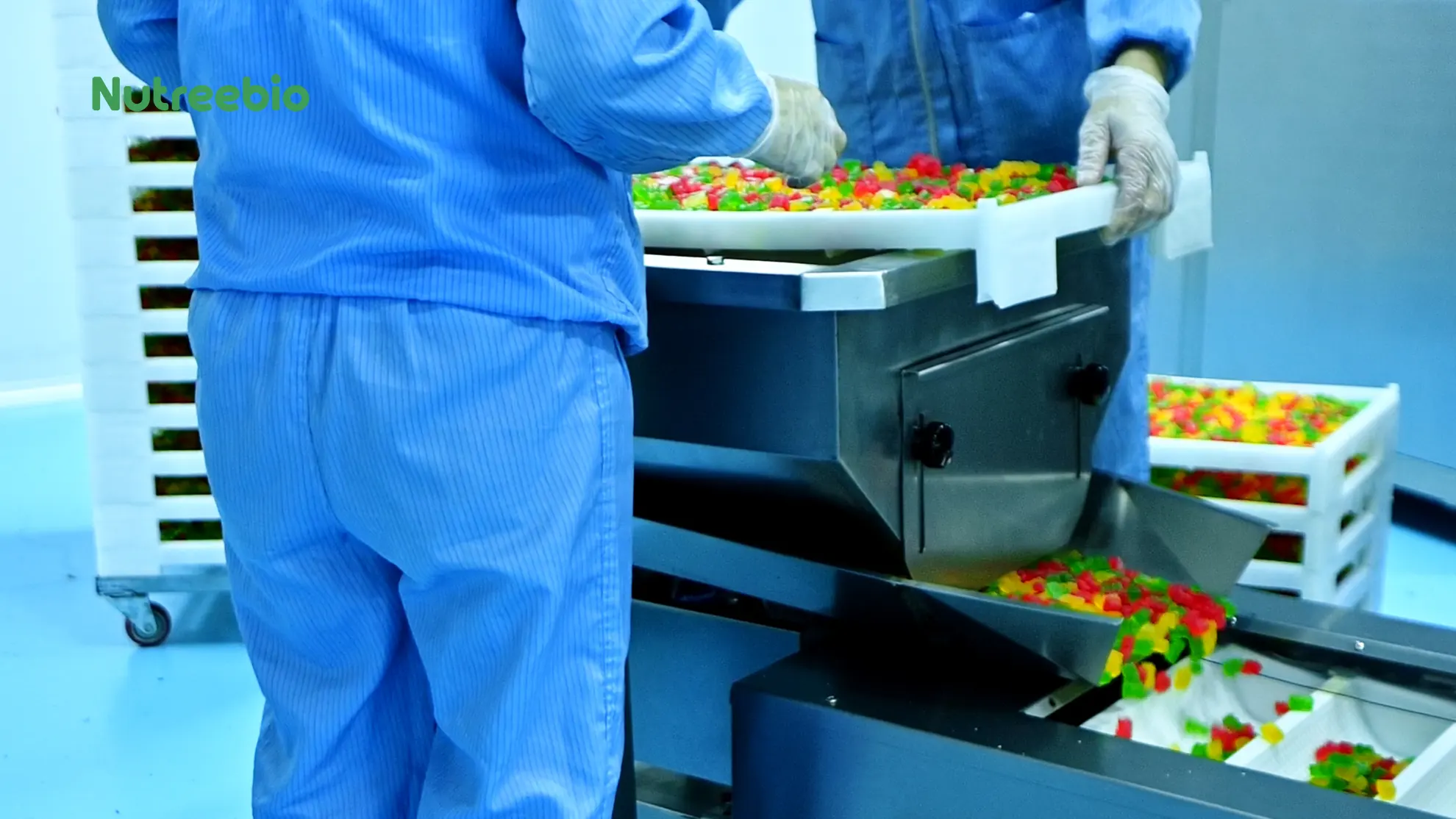
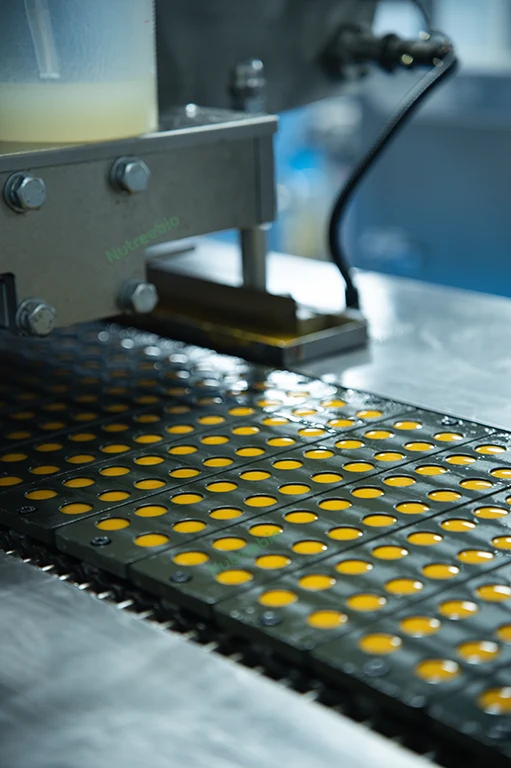
3. Depositing & Molding

The gummy mixture is deposited into custom molds in various shapes and sizes, matching brand requirements.

Gummies Depositing & Molding
Gummies Demolding & Conveying

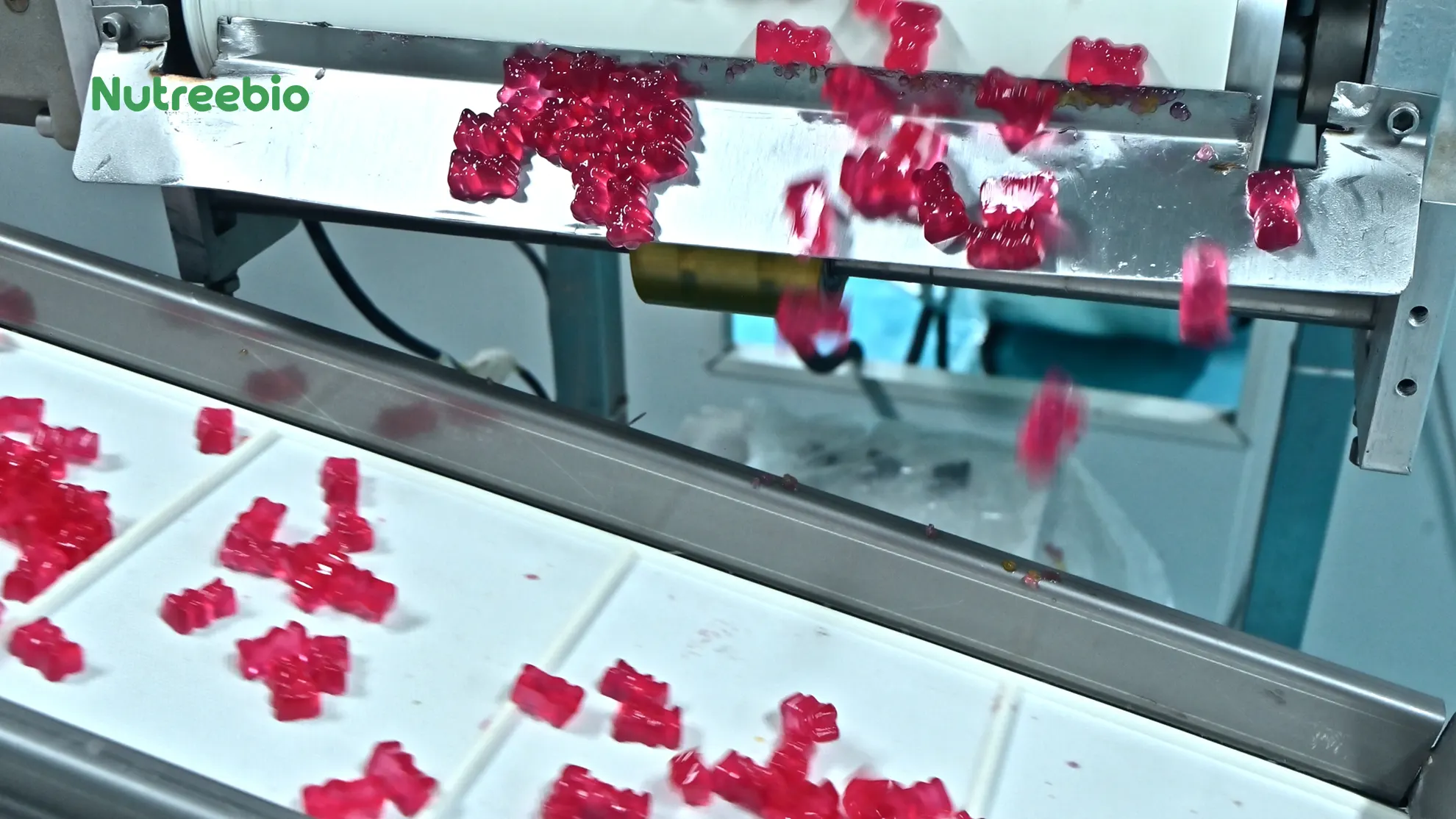
4. Demolding & Conveying

Once set, gummies are gently demolded and conveyed for further processing to maintain shape and texture.

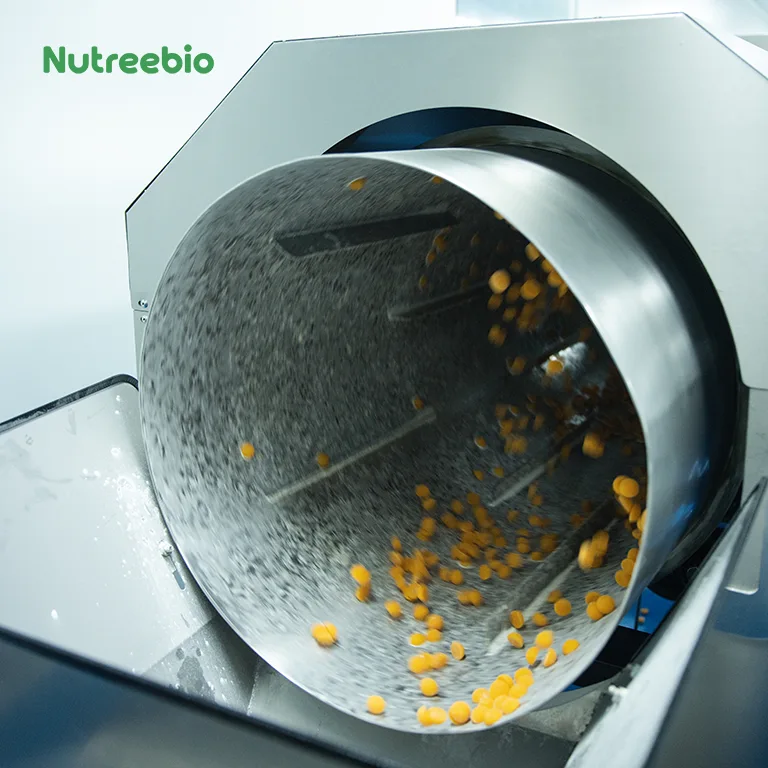
5. Coating & Pre-Drying

Gummies are coated (if required) and undergo an initial drying process to improve stability and prevent sticking.

Gummies Coating & Pre-Drying
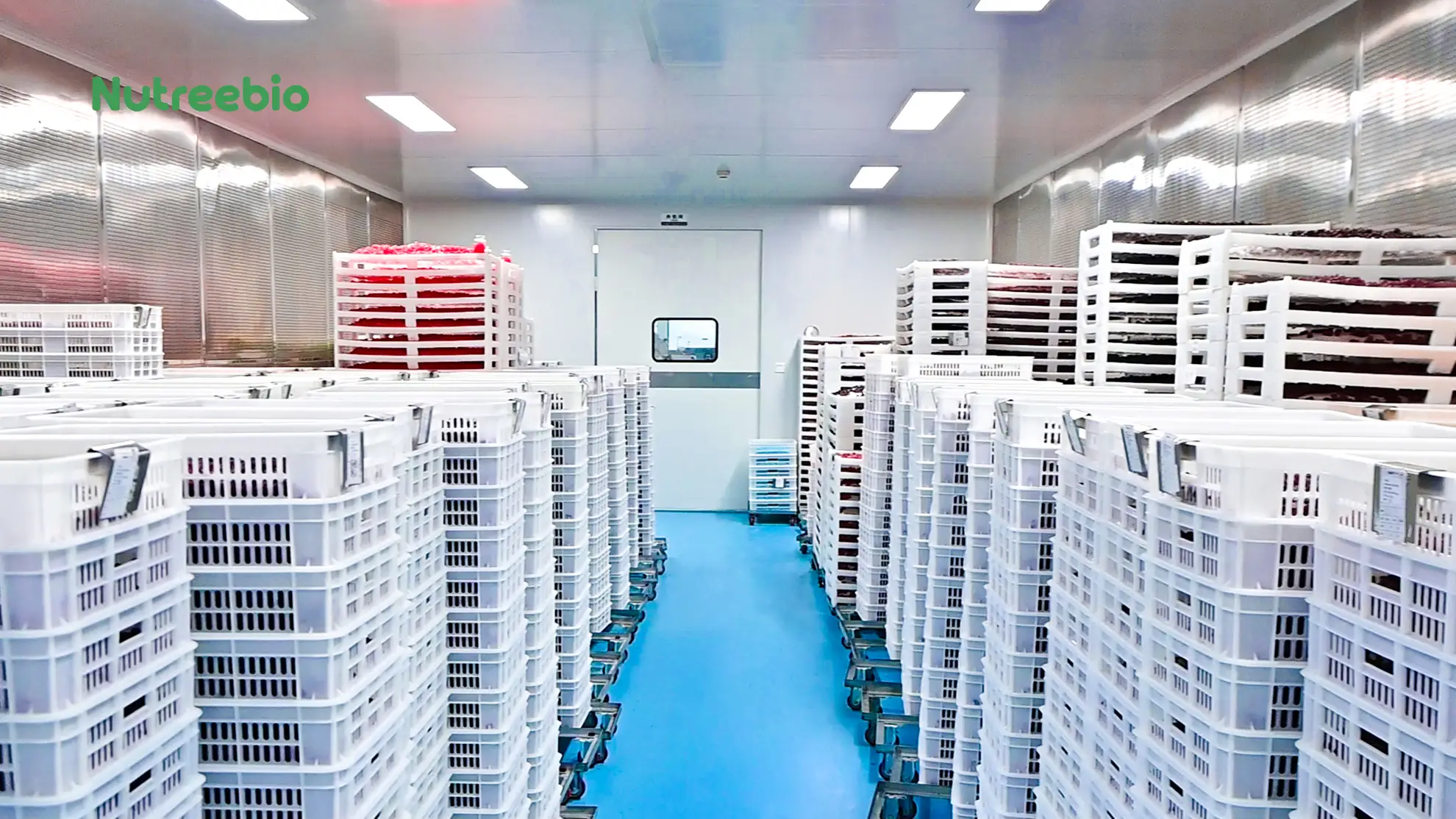
Gummies Drying Room

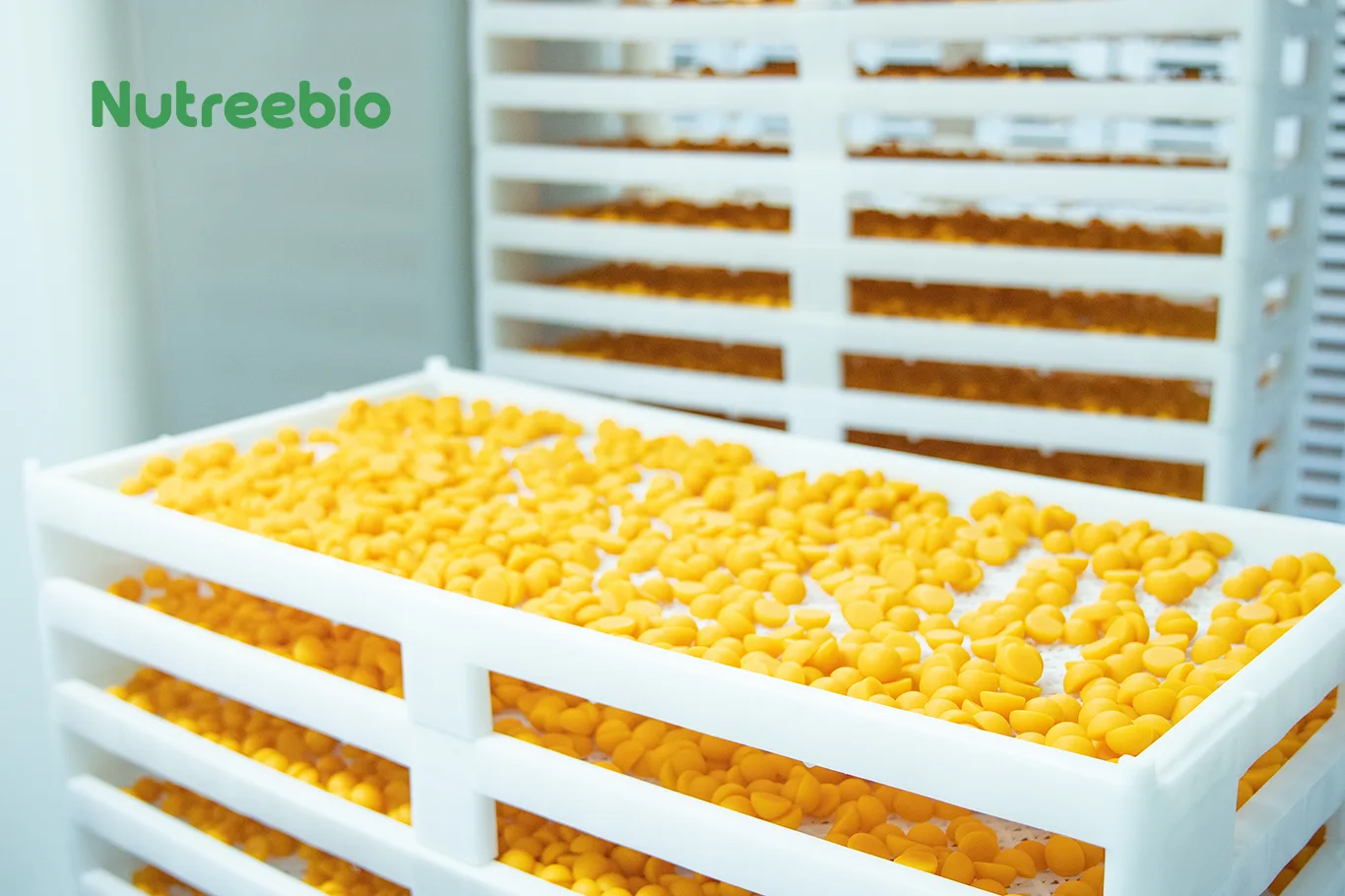
6. Drying Room

Controlled drying conditions ensure the perfect gummy texture, chewiness, and moisture content.

7. Finishing & Polishing

Gummies are polished for a clean, appealing appearance and uniform finish.

Gummies Finishing & Polishing
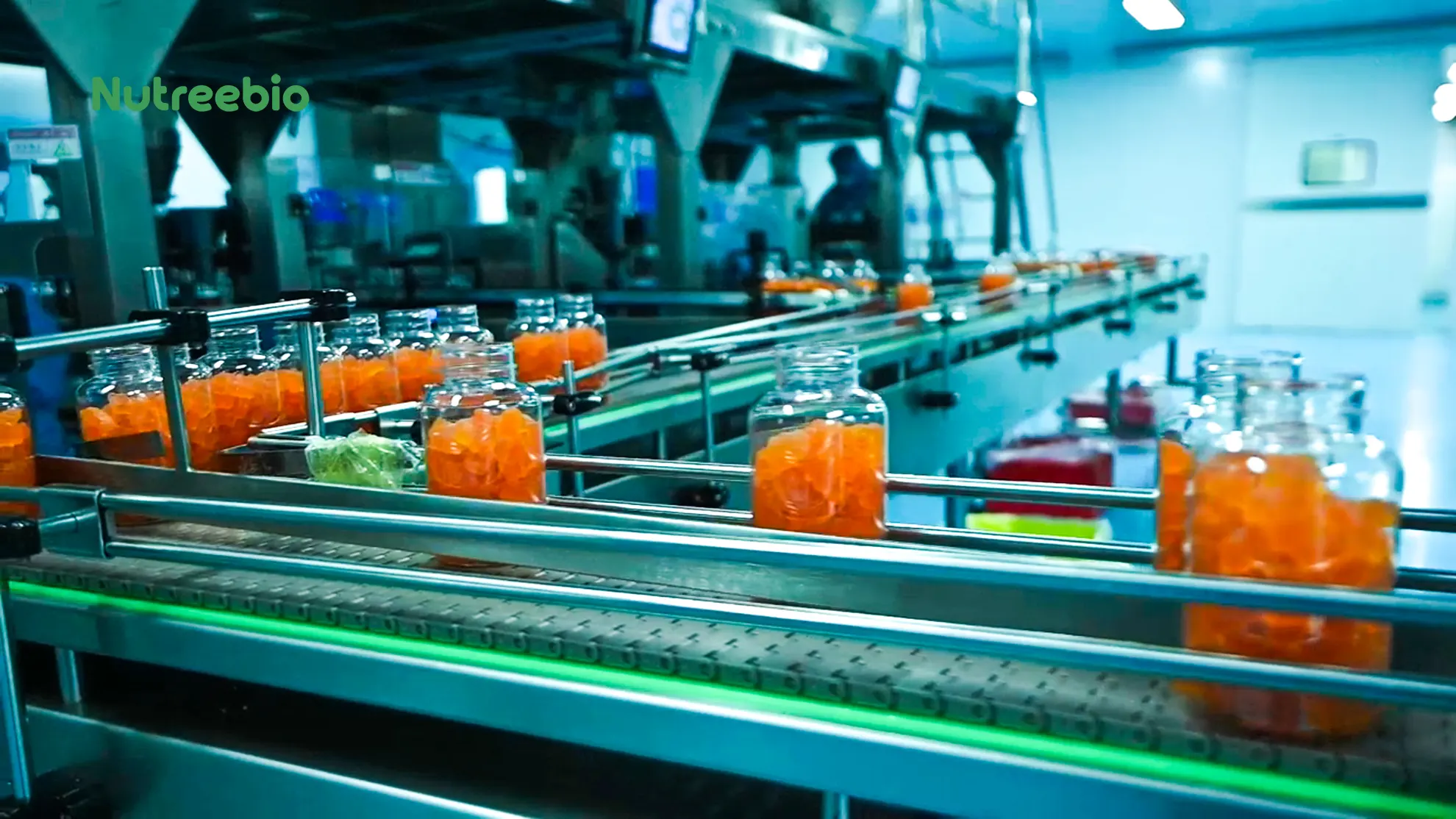
Gummies Filling, Packaging & Labeling

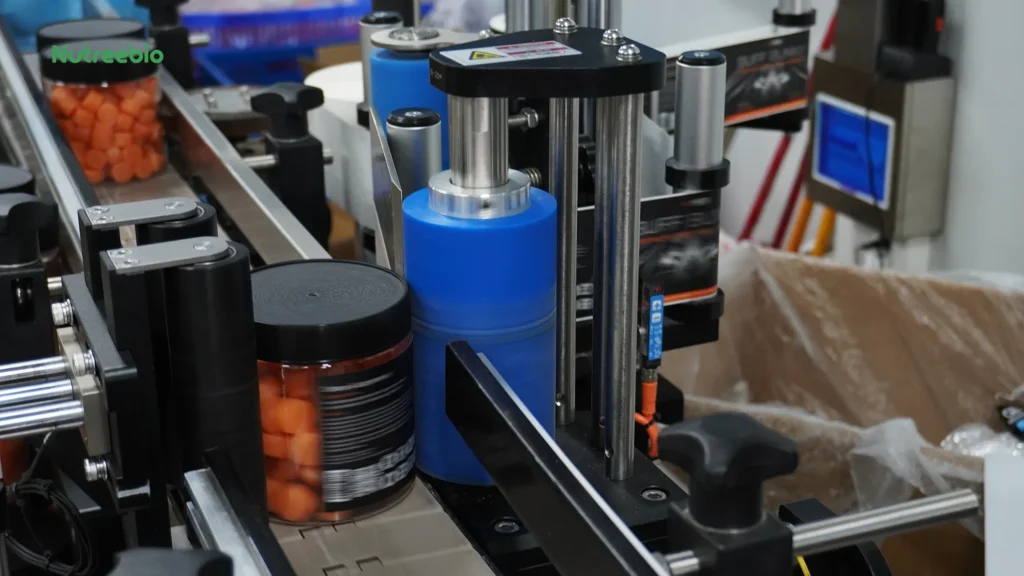
8. Filling, Packaging & Labeling

Finished gummies are counted, filled into bottles or pouches, sealed, labeled, and prepared for shipment.

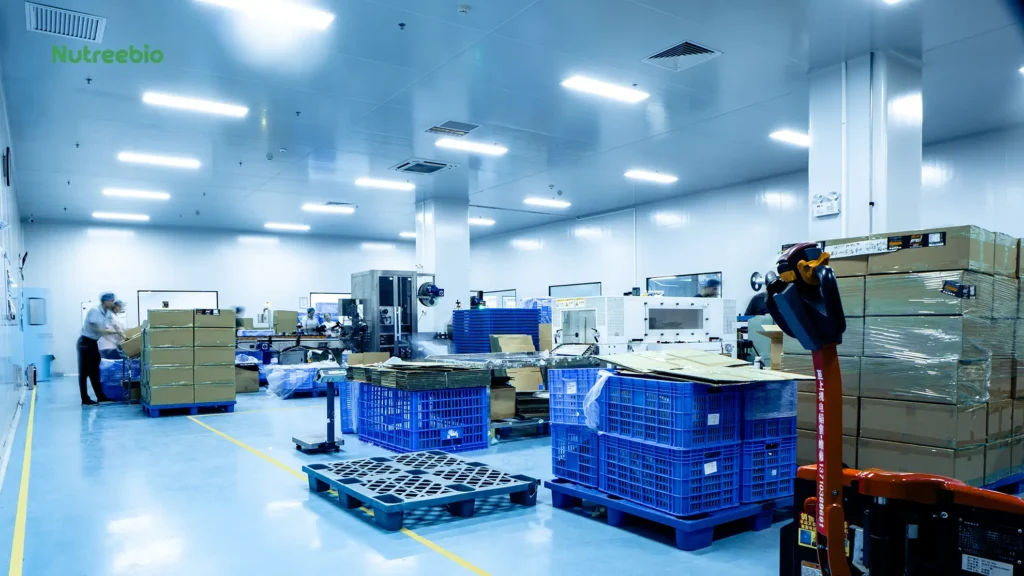
Gummies Packing

Once gummies pass final quality inspection, they are carefully packed in food-grade, tamper-proof packaging to ensure product integrity during transport. From production line to your warehouse, every step is handled with care and precision — ready to deliver your brand’s promise to customers around the globe.

Gummies Packaging Options (bottles)

Packaging Options

Bottles, jars, pouches, or bulk cartons, tailored to your private label requirements.

Secure Sealing & Labeling

Secure Sealing & Labeling

Automated sealing and labeling lines ensure consistency and compliance with your target market regulations.

dsc 8161 拷贝

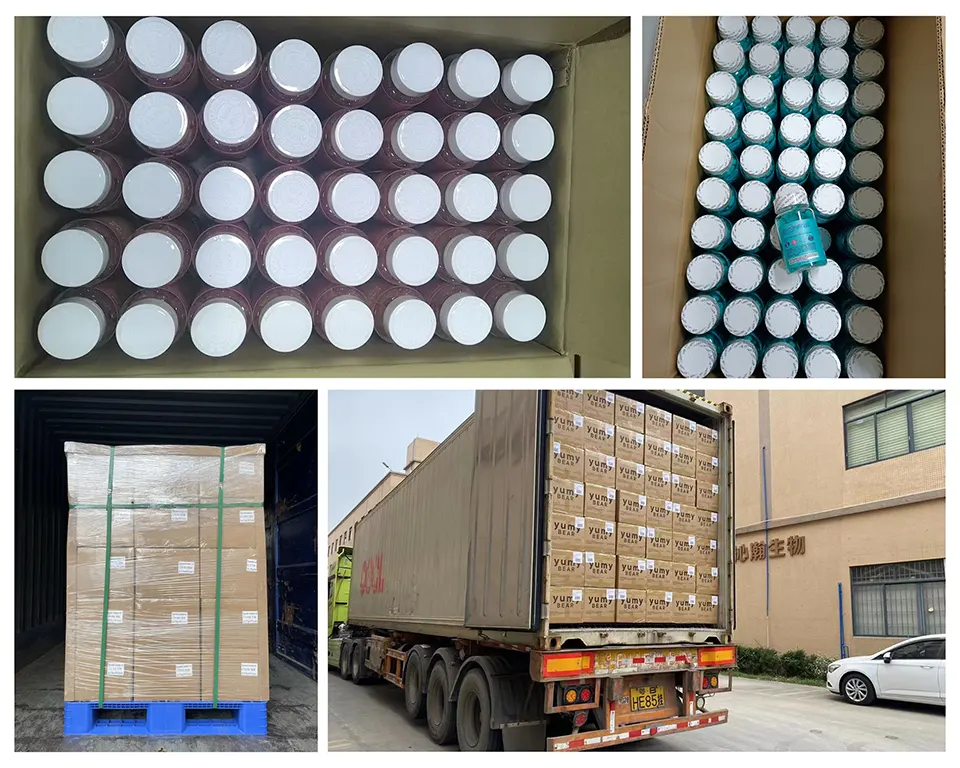
Global Shipping Experience

We coordinate with trusted freight forwarders to arrange sea, air, or express delivery worldwide, ensuring on-time arrival.

Shipping & Fulfillment

Shipping & Fulfillment

As a low MOQ gummy manufacturer, we offer fast and flexible shipping solutions tailored for international markets. Whether you need a small batch for testing or larger volume for retail launch, we ensure timely delivery by air, sea, or door-to-door logistics. All shipments are securely packed and documented for smooth customs clearance.

Our Advantages

Full-Service Support

From label design to lab testing and documentation, we provide comprehensive support to streamline your product launch.

High Quality

We prioritize product quality in every aspect of production, ensuring that our gummies meet the highest industry standards.

Low MOQ

We offer flexibility with a low MOQ starting at just 2000 bottles.

Wide Formula Selection

Choose from a variety of formulas to cater to diverse customer needs.

Short Lead Time

Our efficient manufacturing process means your orders are fulfilled quickly.

❓What is your minimum order quantity (MOQ) for custom gummy manufacturing?

Answer: Our MOQ is flexible and depends on the gummy formula and packaging. For most formulas, we can start from as low as 2,000 bottles or pouches per SKU.

❓Can I customize the formula, flavor, and shape of the gummy?

Answer: Yes. As a custom gummy manufacturer, we offer full customization of ingredients, dosage, gummy shape, flavor, color, surface coating, and packaging — all tailored to your brand and market.

❓Can I provide my own formula and just let you manufacture it?

Answer: Yes, we support full OEM production. If you already have your own gummy formula, we can help you manufacture it to spec, including dosage, flavor, packaging, and compliance testing. Just send us your requirements.

❓Are you certified as a vitamin gummy manufacturer?

Answer: Yes. Our facility is FDA-registered, GMP, ISO22000, BRC, NSF, and HACCP certified. We conduct third-party lab testing to ensure safety and compliance.

❓What certifications do your custom gummies meet for export?

Answer: Our custom gummies comply with standards required for export to the US, EU, UK, Philippines, and Southeast Asia. We support documentation like FDA registration, COA, third-party testing, and ingredient traceability.

❓Do you support labeling and packaging services?

Answer: Yes. We can apply your custom label to bottles or pouches. If needed, our in-house design team can help you create compliant labels (optional service, additional fee).

❓Can you help develop a new gummy formula from scratch?

Answer: Absolutely. Our R&D team provides full custom formulation development, including trending actives, dosage suggestions, taste masking, and stability testing — ideal for new product launches.

❓What kind of packaging do you support for vitamin gummies?

Answer: We offer a variety of packaging options including bottles, jars, pouches, single-serve sachets, and bulk packs. All can be customized with your branding and labeling requirements.

dsc07290 拷贝
❓How do I start a custom gummy project with you?

Answer: Simply send us your requirements—whether a concept, formula, or reference brand. We’ll support you through formulation, sampling, packaging design, manufacturing, and delivery. Low MOQs are available.

❓Can you match the taste and texture of an existing gummy brand?

Answer: Yes, our R&D team can reverse-engineer a reference gummy’s taste, shape, and texture. We can also improve it based on your needs—such as sugar-free, vegan, or high-dose versions.

❓Can I get samples before placing a bulk order?

Answer: Yes, we offer free samples of our standard gummies and can also create custom samples based on your formula and flavor preferences. Sampling helps ensure you’re fully satisfied before scaling up production.

❓Do you have an in-house R&D team for gummy formulation?

Answer: Yes. Our in-house R&D lab includes food scientists and formulation specialists who can develop new gummy products from scratch or optimize your existing formula for taste, stability, and compliance.

❓Can I visit your factory or request a virtual tour?

Answer: Absolutely. You’re welcome to visit our factory in China or request a virtual tour. We believe transparency builds trust and are proud to show our production and QA processes.

What people say

Customers reviews

Learn Before You Launch: Gummy Manufacturing Insights

Before a gummy formula moves into commercial production, the manufacturer must confirm more than its ingredient list. Active dosage, heat sensitivity, pH, texture, moisture, coating, packaging, and destination climate can all affect whether the final gummies remain stable during production, storage, and international shipping.

The following gummy manufacturing insights explain how Nutreebio evaluates production feasibility, controls quality, supports low MOQ projects, and helps buyers reduce avoidable delays before the first commercial batch. Please let me clarify that the following information from NutreeBio focuses on gummy production. If you are interested in detailed options regarding ingredients, flavors, colors, shapes, or branding and packaging, we invite you to explore our “Private Label Gummy” solutions.

Table of Contents

From Formula Concept to a Production-Ready Gummy

Manufacturing feasibility must be confirmed before commercial production!

A formula that works in a capsule, tablet, or powder cannot always be transferred directly into a gummy. Gummies have limited space for active ingredients, and every ingredient becomes part of the gummy’s gel structure. High ingredient loading, mineral salts, botanical extracts, acids, oils, fibers, and moisture-sensitive materials can change the texture, flavor, drying behavior, and shelf stability of the finished product.

Before sampling, our gummy manufacturing team reviews the formula to determine whether the desired dosage can be delivered in a practical gummy weight and serving size. We also evaluate whether the active ingredients are compatible with the selected pectin or gelatin base and whether adjustments may be required for taste, texture, or stability.

Manufacturing FactorWhat We EvaluateWhy It Matters
Active Ingredient LoadTotal active ingredients per gummy and per servingExcessive loading can weaken the gummy structure or require a larger gummy and serving size.
Gummy WeightWhether the dosage fits into a standard 2–5 g gummyGummy weight affects mold selection, serving count, texture, packaging, and cost.
Heat SensitivityStability of vitamins, probiotics, enzymes, and botanical compoundsSensitive ingredients may require controlled addition conditions or stability allowances.
Moisture SensitivityHygroscopic behavior of minerals, fibers, and extractsMoisture-attracting ingredients can increase stickiness and reduce shelf stability.
pH CompatibilityInteraction between acids, active ingredients, and the gelling systempH directly affects pectin setting, texture, taste, and batch consistency.
Solubility and Particle SizeWhether ingredients dissolve or remain suspendedPoor solubility can cause sedimentation, graininess, visible particles, or uneven texture.
Taste ImpactBitterness, mineral notes, herbal aftertaste, acidity, or odorStrong active ingredients may require taste masking or a different serving strategy.
Target Market and ClimateStorage temperature, humidity, and expected transit conditionsThe destination affects coating, drying, packaging, and transport protection.

The goal is not simply to fit as many ingredients as possible into one gummy. A commercially successful formula must balance active dosage, texture, taste, serving size, cost, and shelf stability.

High-Dose Ingredients Require Practical Gummy Design

One of the most common challenges in gummy supplement manufacturing is attempting to add several high-dose ingredients to a small gummy. Minerals, amino acids, collagen, creatine, fiber, and botanical powders can occupy a large proportion of the formula and interfere with gel formation.

When the requested dosage is too high, several options may be considered:

✅ Increasing the gummy weight
✅ Increasing the number of gummies per serving
✅ Reducing nonessential supporting ingredients
✅ Using a more concentrated ingredient source
✅ Separating one complex formula into two products
✅ Moving very high-dose formulas into a powder format

For example, ingredients such as collagen and creatine usually require gram-level servings to reach meaningful dosages. A small gummy can only carry a limited amount without becoming soft, sticky, grainy, or difficult to demold. In these cases, the formula must be designed around realistic manufacturing limits rather than label appearance alone.

Laboratory Sample VS Commercial Gummy Production

Initially, we send small gummy samples to clients, whereas commercial orders for bulk production come later. It is worth noting that the samples originate from the laboratory, while commercial orders come from the factory production line.

Laboratory samples are important for confirming flavor, texture, color, appearance, and general formula feasibility. However, laboratory equipment and commercial production lines operate at very different scales.

A small sample may be prepared using a laboratory cooker and hand-filled molds. A commercial batch requires larger cooking vessels, controlled transfer, automated depositing, continuous molding, drying rooms, polishing equipment, and filling lines. Heating time, viscosity, cooling speed, depositing temperature, and drying behavior can change when the batch is scaled up.

Our scale-up process generally includes the following stages:

StageMain ObjectiveKey Review Points
1. Formula Feasibility ReviewConfirm that the proposed dosage and ingredients are suitable for a gummyActive load, pH, solubility, heat sensitivity, and gummy weight
2. Laboratory SampleEstablish the target flavor, texture, color, and appearanceTaste masking, sweetness, acidity, chewiness, and shape
3. Formula RefinementAdjust the sample according to buyer feedback and stability observationsDosage, flavor balance, texture, coating, and ingredient compatibility
4. Production Scale-UpTransfer the approved formula to commercial equipmentCooking conditions, viscosity, depositing, mold release, and drying behavior
5. Commercial Batch ControlKeep the finished batch aligned with the approved specification

Weight, appearance, texture, moisture, testing, and packaging

Minor adjustments may be required during scale-up to maintain the approved texture and appearance. These adjustments should not change the confirmed product positioning or declared active dosage without buyer approval.

Why Gummy Texture Can Change During Scale-Up

Simply put, cooking, depositing, cooling, and drying must function as a single system.

Gummy texture is not controlled by one ingredient alone. It results from the interaction of the gelling agent, sweetener system, water, acids, active ingredients, cooking conditions, depositing temperature, cooling, and drying.

Common scale-up risks include:

gih 2476 拷贝

For this reason, commercial gummy manufacturing requires coordinated control from cooking through final packaging. Correcting one stage without considering the others can create a new problem later in the process.

Critical Quality Controls During Gummy Manufacturing

Consistent gummy manufacturing depends on controlled raw materials, documented batch instructions, in-process inspection, and finished-product release checks. The exact testing plan depends on the formula, destination market, and customer requirements.

Production StageTypical Control PointManufacturing Purpose
Raw Material ReleaseSupplier documents, COA, lot number, appearance, and storage conditionPrevent incorrect or nonconforming materials from entering production.
Formula PreparationApproved formula, ingredient quantities, and batch recordsEnsure that the correct materials and amounts are used.
CookingTemperature, time, solids, pH, and viscositySupport consistent gel formation, texture, and depositing.
DepositingGummy weight, mold fill, shape, and visual uniformityMaintain consistent unit weight and serving calculations.
DemoldingMold release, shape retention, breakage, and surface conditionPrevent deformation and excessive product loss.
DryingTime, temperature, humidity, moisture, and water activity where requiredControl chewiness, stickiness, microbial stability, and shelf life.
FinishingCoating uniformity, surface appearance, texture, and sortingImprove flow, appearance, and packaging performance.
Finished-Product TestingMicrobiology, heavy metals, active ingredients, or nutrition values as requiredConfirm that the batch meets the agreed product specification.
Packaging ReleaseCount, net weight, seal, label, batch code, and carton marksProtect the gummies and ensure correct finished-product presentation.
Batch TraceabilityProduction records, raw material lots, finished-product lot, and retained samples

Support quality investigation and document review when needed.

Testing requirements should be confirmed before production. If the buyer requests active ingredient testing, third-party laboratory reports, retailer-specific testing, or market registration documentation, we recommend clarifying these requirements during the quotation and formulation confirmation stages.

For this reason, commercial gummy manufacturing requires coordinated control from cooking through final packaging. Correcting one stage without considering the others can create a new problem later in the process.

Low MOQ Gummy Manufacturing: What’s Possible, What’s Not

One of the most common questions we receive from global buyers is: “Can I start with a low MOQ?”
The answer is: Yes — but it depends. Let us explain.

Why Does MOQ Exist in Gummy Manufacturing?

Unlike powders or capsules, gummies require specialized equipment and production preparation. Even for small orders, there are fixed costs involved in:

🧩 Mold installation: Each shape (bear, drop, dome) must match your gummy’s volume and texture, which involves physical trays or steel rollers.

⚗️ Formula batching: Ingredients must be cooked, blended, and poured — even for 2,000 bottles, the kitchen and machines are fully activated.

🏭 Machine setup and cleaning: Startup, heating, cooling tunnels, and post-cleaning must be done per flavor or active ingredient.

🎨 Label and packaging print: Bottles, pouches, or boxes require minimum print runs for economic cost-per-unit.

These baseline costs are independent of quantity — and that’s what sets the MOQ floor.

For many standard formulas and packaging formats, Nutreebio can support low MOQ gummy manufacturing from approximately 2,000 bottles or pouches per SKU. Bulk gummy projects generally start from approximately 500 kg, depending on the formula, gummy weight, coating, and packing method.

These quantities are designed to support:

MOQ is not determined only by the number of bottles ordered. Even a small commercial batch requires raw material preparation, formula batching, equipment setup, cooking, depositing, drying-room capacity, line cleaning, quality checks, packaging setup, and production records.

What Determines the MOQ for Gummy Manufacturing?

MOQ FactorHow It Affects the Project
Formula ComplexityMulti-ingredient or high-dose formulas may require a larger production batch and more development work.
Raw Material MOQBranded, imported, uncommon, or custom ingredients may have their own supplier minimums.
Gummy WeightGummy size affects mold compatibility, batch yield, serving count, and packaging.
Mold SelectionExisting molds support lower MOQ, while a custom logo or new shape requires tooling.
Number of FlavorsEach flavor normally requires separate preparation, line setup, and cleaning.
Number of ColorsMultiple colors can create separate processing requirements.
CoatingSpecialized sugar, acid, or layered coatings may increase setup and drying requirements.
Sugar-Free FormulaAlternative sweetener systems may require additional formulation and stability work.
Packaging TypeStandard bottles and pouches are more flexible than specially molded or custom-printed packaging.
Testing RequirementsActive testing, stability testing, or retailer-specific testing adds project cost and time.

The lowest MOQ is normally achieved when the project uses a single or established formula, an existing gummy mold, and a standard bottle or pouch.

What Can Be Customized at Low MOQ?

Low MOQ does not necessarily mean a completely standard product. Many projects can still customize:

✅ Active ingredients and dosage within production limits
✅ Pectin or gelatin base
✅ One selected flavor
✅ One color
✅ Existing gummy shapes
✅ Standard oil or wax coating
✅ Bottle or pouch packaging
✅ Printed labels
✅ Standard cartons
✅ Required quality testing

Some options are more difficult or uneconomical at approximately 2,000 units:

🔴 Newly tooled custom gummy molds
🔴 Embossed brand logos on the gummy
🔴 Several flavors or colors in one small order
🔴 Multiple formulas sharing one batch
🔴 Rare ingredients with high supplier MOQs
🔴 Gummies with an incredibly complex production process
🔴 Fully customized bottles or lids with high tooling costs
🔴 Very small quantities divided across many SKUs

These options may become more practical when order volume increases.

How to Keep Your First Gummy Order Practical

Brands can reduce first-order cost and manufacturing risk by following a focused launch plan:

1️⃣ Use an existing gummy mold
Bears, drops, domes, hearts, and other standard and common shapes avoid custom tooling costs.

2️⃣ Start with one flavor and one color
Each additional version may require separate batching, setup, and cleaning.

3️⃣ Use a standard bottle or pouch
Standard packaging normally has better availability and a more flexible MOQ.

4️⃣ Confirm the active dosage early
Major formula changes after sampling can require new development and pricing.

5️⃣ Limit unnecessary supporting ingredients
A focused formula is often easier to stabilize than a long ingredient list.

6️⃣ Check special raw material minimums
Branded or uncommon ingredients may create a higher MOQ than the gummy production itself.

7️⃣ Confirm testing requirements before quotation
Testing added after production can delay release and create unexpected costs.

8️⃣ Launch one core SKU before expanding
New flavors, shapes, and related formulas can be added after market demand is confirmed.

Low MOQ Trial Launch vs Full-Scale Production

The right production strategy depends on your launch stage:

Project AreaLow MOQ Trial LaunchFull-Scale Production
Main ObjectiveTest the product and market responseImprove unit economics and maintain supply
Formula StrategyFocused formula with practical ingredientsGreater flexibility for premium or specialized materials
Number of SKUsUsually one formula and one flavorMultiple flavors, formulas, or serving formats
Mold SelectionExisting shapes are recommendedCustom molds and embossed designs become more practical
PackagingStandard bottle or pouch with custom labelGreater flexibility for custom-printed packaging and cartons
Unit CostHigher because setup costs are spread across fewer unitsLower as fixed costs are distributed across more units
Testing PlanEssential release testing based on market needsBroader testing, retailer programs, or ongoing stability work may be added
Inventory RiskLowerRequires stronger demand planning

A low MOQ project should be treated as a controlled commercial launch, not as a laboratory sample. The product still needs an approved formula, packaging, batch documentation, testing plan, and finished-product specification.


Why Gummy Texture Can Change During Scale-Up

Gummy texture is not controlled by one ingredient alone. It results from the interaction of the gelling agent, sweetener system, water, acids, active ingredients, cooking conditions, depositing temperature, cooling, and drying.

Common scale-up risks include:

For this reason, commercial gummy manufacturing requires coordinated control from cooking through final packaging. Correcting one stage without considering the others can create a new problem later in the process.

Drying Is a Critical Part of Gummy Stability

Freshly deposited gummies normally contain too much moisture for immediate packaging. Controlled drying is required to develop the intended chewiness, reduce surface tackiness, and improve storage stability.

For many pectin-based gummy projects, drying may take approximately 24–36 hours. The actual time depends on:

Gummies Drying

Drying too quickly may create a firm outer surface while leaving excessive moisture inside. Drying for too long may produce gummies that are hard, brittle, or difficult to chew. A stable result requires controlled moisture reduction throughout the gummy rather than surface drying alone.

The final drying target is formula-specific. Moisture content, water activity, texture, and storage observations should be evaluated together rather than relying on one universal number.

What Affects Gummy Manufacturing Lead Time?

Commercial lead time begins after the formula, sample, packaging, and order details are confirmed. Changes made after approval can restart part of the process.

Project StagePossible Lead-Time Factors
Formula ReviewIngredient compatibility, active dosage, serving size, and target market requirements
Raw Material PreparationAvailability of branded, imported, or uncommon ingredients
Sample DevelopmentNumber of flavor, texture, color, or dosage revisions
Packaging PreparationStock packaging versus custom-printed bottles, pouches, lids, or cartons
Production SchedulingBatch size, line availability, number of SKUs, and allergen or cleaning requirements
DryingGummy base, size, active ingredients, coating, and target moisture
Finished TestingMicrobiology, heavy metals, active ingredient, nutrition, or third-party testing
Shipment

Destination, transport method, customs documents, and seasonal logistics capacity

To protect the schedule, the final formula, approved sample, packaging artwork, testing requirements, and shipping method should be confirmed before production begins.

Common Gummy Manufacturing Mistakes

Avoid delays, reformulation, and unnecessary cost before the first batch

1. Changing the Formula After Sample Approval

Replacing an ingredient or changing the active dosage can affect texture, flavor, cost, and stability. Even a small formula change may require new sampling.
Manufacturing recommendation: Confirm the full ingredient list and dosage before approving the final sample.

2. Adding Too Many High-Dose Active Ingredients

A long ingredient list may look attractive on the label but can overload the gummy base and create a soft, sticky, grainy, or unstable product.
Manufacturing recommendation: Prioritize the main functional ingredients and keep the serving size realistic.

3. Assuming Every Ingredient Behaves the Same in a Gummy

Minerals, botanical extracts, oils, fibers, vitamins, and amino acids interact differently with heat, moisture, acid, and pectin.
Manufacturing recommendation: Complete a formula-feasibility review before committing to packaging or marketing claims.

4. Treating the Laboratory Sample as a Finished Production Method

A hand-prepared sample does not automatically confirm that the formula can run efficiently on commercial depositing and drying equipment.
Manufacturing recommendation: It is normal for there to be differences between handmade gummy samples and those produced on a large-scale production line. Aim to finalize parameters before full-scale production begins, or adhere to the specifications established during the sampling phase, and avoid making frequent changes.

5. Requesting Several Flavors in One Small Batch

Each flavor or color may require separate preparation, equipment adjustment, and cleaning.
Manufacturing recommendation: Begin with one flavor for a low MOQ launch and expand after market validation.

6. Choosing a Custom Mold for a Very Small Order

Custom molds increase costs and development time, so they may not be cost-effective for orders of fewer than 2,000 units.
Manufacturing recommendation: Use an existing mold for the first order unless the shape is central to the product concept.

7. Confirming Packaging Too Late

Packaging dimensions affect label size, serving count, desiccant selection, carton configuration, and production planning.
Manufacturing recommendation: Confirm the bottle or pouch before finalizing label artwork.

8. Adding Testing Requirements After Production

Some active ingredient or third-party tests require specific sampling plans, specifications, or additional quantities.
Manufacturing recommendation: Agree on the testing plan before quotation and production.

9. Ignoring Destination Climate

A coating and packaging system suitable for a temperate market may not perform the same way during prolonged transport through hot and humid regions.
Manufacturing recommendation: Inform the manufacturer of the destination country and expected shipping conditions during development.

Export-Ready Gummy Manufacturing

Once the gummies pass the agreed release checks, they can be filled into bottles, pouches, or bulk packaging. Depending on the project, packaging components may include induction seals, desiccants, shrink bands, printed labels, batch codes, expiry information, outer cartons, and shipping marks.

For export orders, Nutreebio can help coordinate:

✅ Finished-product specifications
✅ Certificate of Analysis
✅ Available manufacturing certificates
✅ Ingredient and raw material documents
✅ Third-party laboratory reports where requested
✅ Packing lists and commercial invoices
✅ Carton labels and shipping marks
✅ Air, sea, express, or door-to-door logistics
✅ Customs-clearance documentation support

The specific certificates available depend on the selected production facility and product category. You can review our “Certifications and Quality Standards” page for more information.

Packaging and logistics should be evaluated together. Bottle count, pouch material, carton strength, pallet configuration, transport duration, and destination climate can all affect the condition in which the gummies arrive.

Struggling to find a gummy vitamin supplier that understands your brand’s unique needs?

Nutreebio supports gummy supplement projects from formula-feasibility review and sampling through commercial production, quality documentation, packaging, and international delivery. Share your formula, target dosage, destination market, packaging format, and estimated quantity, and we will help you evaluate the most practical manufacturing plan.

Nutreebio logo

Ask For A Quick Quote

We will contact you within 1 working day, please pay attention to the email with the suffix “info@nutreebio.com”

GET FREE SAMPLES NOW!

We’d love to hear from you! Send us a message using the form