In the new year of 2026, my first research topic is the sweeteners in gummies. It's been almost four years since I last wrote about the sugar content in gummies. In these four years, we've conducted extensive research and exploration with the factory, arriving at many new conclusions, which is why I'm writing this article to share them with everyone.
Sweeteners play a central role in gummy formulation, but choosing the right one is not simply a matter of selecting the sweetest option. In gummy products, sweetness must work together with texture, mouthfeel, processing performance, label positioning, and overall consumer experience. A sweetener that performs well in a beverage may not deliver the same result in a gummy, where chewiness, solids content, aftertaste, and sugar-reduction goals all need to be carefully balanced.
For brands developing gummies today, the challenge is no longer just how to make a product sweet. It is how to create the right sweetness profile for the right product. Traditional sugars, polyols, and high-intensity sweeteners each bring different advantages and limitations. Some contribute bulk and body, some help support sugar-free positioning, and some are mainly used to fine-tune sweetness with very low addition levels. In many modern gummy formulas, the best solution is not a single sweetener, but a well-designed sweetening system.
In this article, we compare common sweeteners by relative sweetness, explain their functional differences, and look at how they are used in gummy formulation. We also explore the future direction of sweeteners in gummies, as the market continues to move toward reduced sugar, cleaner labels, and better-tasting functional products.
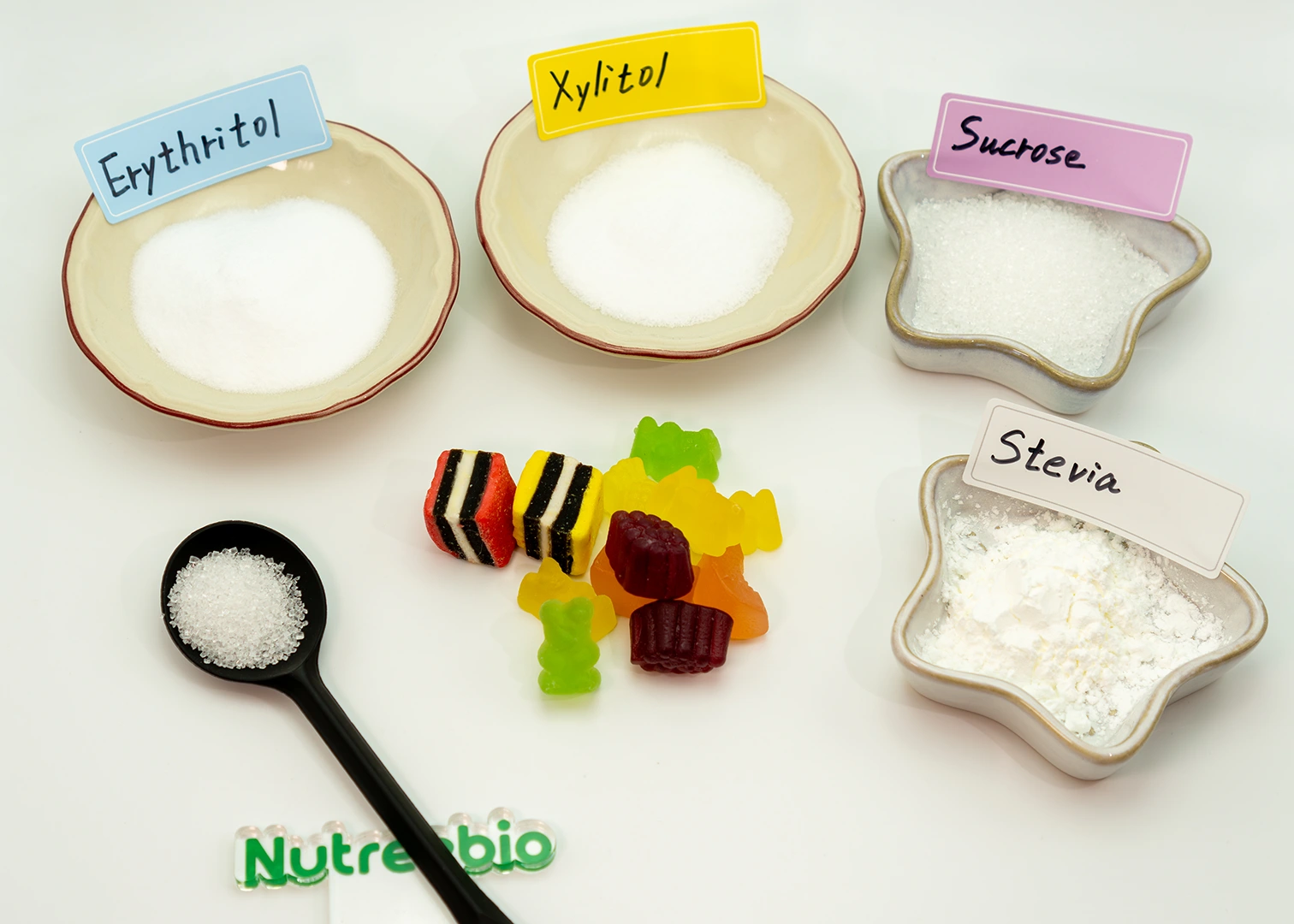
1. How Sweetness Is Measured: Relative Sweetness Compared with Sucrose
When discussing sweeteners, the most common reference point is sucrose. In food formulation, sucrose is typically assigned a relative sweetness value of 1.0, and other sweeteners are compared against it under similar conditions. If a sweetener has a relative sweetness of 200, it means it can deliver approximately the same perceived sweetness as sucrose at only a fraction of the usage level. This system makes it easier to compare ingredients that differ greatly in potency, from traditional sugars to high-intensity sweeteners.
However, relative sweetness should be understood as a practical guideline rather than an absolute number. The perceived sweetness of an ingredient can change depending on temperature, pH, concentration, flavor system, and the overall product format. A sweetener may behave one way in a beverage and another way in a gummy. This is especially important in gummy development, where the sweetness experience is influenced not only by the sweetener itself, but also by acids, active ingredients, fruit flavors, texture, and chew time.
For gummy brands and formulators, relative sweetness is a useful starting point, but it is not the only factor that matters. Two sweeteners may appear similar on a sweetness chart yet perform very differently in a finished gummy. Some contribute bulk, body, and solids, while others provide sweetness only and must be used together with other ingredients. Some have a clean, rounded sweetness profile, while others may deliver a faster onset, a shorter finish, a cooling effect, or a lingering aftertaste.
This is why the “sweetest” sweetener is not automatically the best sweetener for gummies. In practice, choosing a sweetener requires a broader view—one that considers sweetness intensity together with texture, stability, taste profile, label claims, and product positioning. Relative sweetness helps establish the framework, but successful gummy formulation depends on how that sweetness performs in the real product.
2. Sweetness Ranking of Common Sweeteners
Based on relative sweetness compared with sucrose, sweeteners used in food and gummy formulation can be broadly grouped into three categories: ultra-high-intensity sweeteners, high-intensity sweeteners, and bulk sweeteners such as sugars and polyols. This classification is helpful because it shows not only how sweet an ingredient is, but also how differently it may function in a formula.
Ultra-high-intensity sweeteners are used at extremely low addition levels because they are hundreds or even thousands of times sweeter than sucrose. High-intensity sweeteners are also very potent, but generally fall into a lower sweetness range. By contrast, sugars and polyols are much closer to sucrose in sweetness and are often used not only for sweetness, but also for bulking, mouthfeel, and texture. In gummy development, this distinction is especially important because sweetness alone is never the full story.
Relative Sweetness of Common Sweeteners Used in Gummies
| Category | Sweetener | Relative Sweetness (vs. Sucrose = 1.0) | Typical Role in Gummies |
|---|---|---|---|
| Ultra-high-intensity sweeteners | Advantame | 20,000 | Very high sweetness potency; used at extremely low levels |
| Ultra-high-intensity sweeteners | Neotame | 7,000–8,000 | High-potency sweetener for very low-use applications |
| Ultra-high-intensity sweeteners | Sucralose | 600 | Commonly used to boost sweetness in reduced-sugar or sugar-free formulas |
| Ultra-high-intensity sweeteners | Saccharin | 300–500 | High-potency sweetener, often used in blends |
| Ultra-high-intensity sweeteners | Monk Fruit Extract (Mogrosides) | 150–250 | Plant-derived high-intensity sweetener, often used in clean-label positioning |
| High-intensity sweeteners | Steviol Glycosides (Stevia) | 200–350 | Plant-derived sweetener used in low-sugar and sugar-free systems |
| High-intensity sweeteners | Aspartame | 200 | Sweetness booster, often used where a sugar-like taste profile is desired |
| High-intensity sweeteners | Acesulfame K | 200 | Common blending sweetener to enhance sweetness impact |
| High-intensity sweeteners | Cyclamate | 30 | Lower-potency high-intensity sweetener, often used in combination systems |
| Sugars and polyols | Fructose | 1.1–1.2 | Nutritive sweetener with relatively high sweetness among common sugars |
| Sugars and polyols | Xylitol | 1.0 | Polyol with sucrose-like sweetness; often used in sugar-free positioning |
| Sugars and polyols | Sucrose | 1.0 | Standard reference sweetener; contributes sweetness and solids |
| Sugars and polyols | Allulose | 0.7 | Reduced-calorie bulk sweetener increasingly used in modern formulations |
| Sugars and polyols | Glucose | 0.7 | Traditional sugar contributing sweetness and functional solids |
| Sugars and polyols | Erythritol | 0.6–0.7 | Sugar-free bulk sweetener with low calories and a cooling effect |
| Sugars and polyols | Sorbitol | 0.5–0.6 | Polyol used for sweetness and humectancy |
| Sugars and polyols | Mannitol | 0.5–0.6 | Polyol with lower sweetness, sometimes used in sugar-free systems |
| Sugars and polyols | Isomalt | 0.45–0.65 | Polyol commonly used in sugar-free confectionery |
| Sugars and polyols | Maltitol | 0.4 | Polyol widely used to replace sugar while maintaining sweetness and body |
| Sugars and polyols | Maltose | 0.3–0.5 | Lower-sweetness sugar sometimes present in syrup systems |
| Sugars and polyols | Lactose | 0.2 | Low-sweetness sugar with limited use in most gummy systems |
For a broader look at sugars commonly used in gummy manufacturing, you can also read our guide to common gummy sugar types.
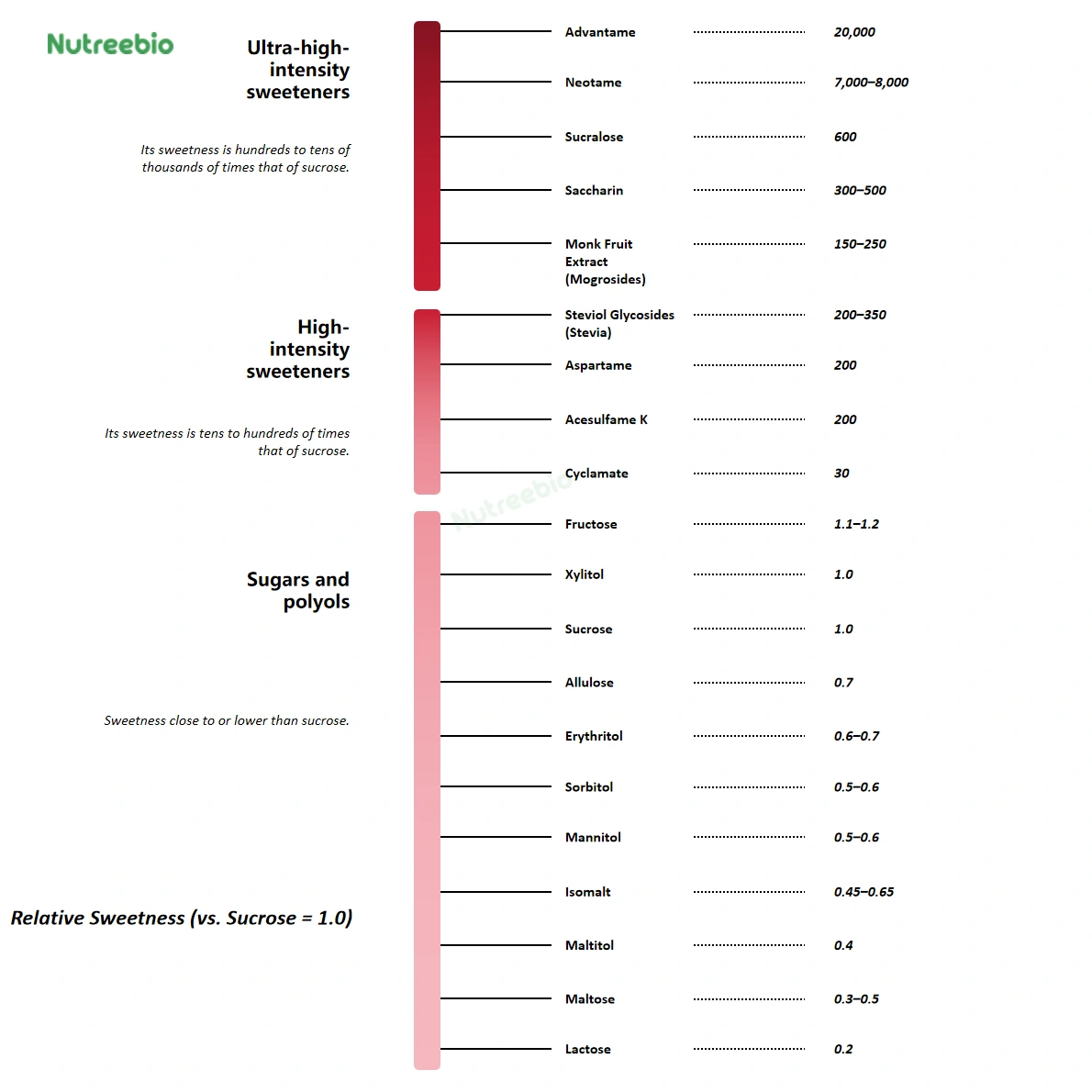
This comparison shows a very important principle in sweetener selection: the ingredients with the highest sweetness intensity are not necessarily the most functionally complete. In gummy products, many ultra-high-intensity and high-intensity sweeteners can provide sweetness efficiently, but they do not contribute the same bulking effect, body, or chew as traditional sugars or polyols. That is why gummy formulas often rely on more than one type of sweetener system rather than a single ingredient alone.
It is also worth noting that sweetness values are only part of the practical picture. For example, sucrose remains a benchmark not only because of its sweetness level, but also because of its familiar taste profile and well-rounded sweetness curve. Polyols such as erythritol, xylitol, and maltitol are valuable in reduced-sugar and sugar-free gummies, but each brings its own sensory and functional characteristics. Similarly, high-intensity sweeteners such as sucralose, stevia, monk fruit, or acesulfame K are often used to fine-tune sweetness, improve cost efficiency, or support specific label claims, especially when paired with bulk sweeteners.
In short, a sweetness ranking helps explain potency, but gummy formulation requires a more complete view. The most suitable sweetener is rarely chosen based on sweetness alone. Instead, formulators need to consider how that sweetener behaves in a gummy matrix, how it interacts with acids and active ingredients, and how it supports the final product’s positioning—whether the goal is a traditional sugared gummy, a reduced-sugar gummy, or a fully sugar-free functional gummy.
3. Why Sweetness Alone Is Not Enough in Gummy Formulation
A sweetness ranking is useful, but in real gummy development, sweetness intensity is only one part of the decision. A gummy is not a simple liquid system where a sweetener only needs to deliver sweetness. It is a structured product with its own texture, chew, moisture balance, flavor profile, and processing demands. For this reason, the “sweetest” ingredient is not automatically the most suitable one. In practice, gummy formulators must evaluate sweeteners not only by sweetness level, but also by how they behave inside the full gummy system.
3.1 Bulking Effect and Texture Matter Just as Much as Sweetness
One of the biggest differences between sweeteners is whether they contribute bulk. Traditional sugars and many bulk sweeteners do more than make a gummy taste sweet—they also provide mass, solids, mouthfeel, and support for the final texture. In a gummy, that matters a great deal. A formula built only around high-intensity sweeteners may achieve the target sweetness, but it will not automatically achieve the desired chew, body, or eating experience.
This is why sucrose, glucose syrup, fructose syrup, allulose, maltitol, and other bulk sweeteners remain highly relevant in gummy development. They help create the physical structure of the product. By contrast, sweeteners such as sucralose, stevia, monk fruit, acesulfame K, advantame, or neotame are used at very low levels and mainly contribute sweetness intensity rather than structure. They can be excellent tools, but they are not direct one-to-one replacements for sugars in terms of functionality.
For gummy brands, this is an important practical point. Replacing sugar is not simply a matter of choosing a sweeter ingredient. Once sugar is reduced or removed, formulators often need to rebuild other aspects of the system as well, including solids balance, texture, stickiness, moisture behavior, and overall mouthfeel.
3.2 Sweetness Profile Is Different from Sweetness Intensity
Two sweeteners can produce a similar sweetness level on paper and still create very different sensory experiences in the mouth. This is because sweetness is not only about how strong it is, but also how it develops over time. In gummy products, the sweetness profile can be especially noticeable because the product is chewed rather than swallowed immediately. The sweetness may build gradually, peak quickly, fade fast, or linger after the gummy has been consumed.
Sucrose remains the historical benchmark not only because of its relative sweetness, but also because of its familiar and balanced sweetness curve. Its onset is generally smooth, and its sweetness is often perceived as round, full, and stable. This is one reason why sucrose continues to be the sensory reference point for so many other sweeteners.
Other sweeteners can behave quite differently. Erythritol, for example, may give a faster and shorter sweetness impression, sometimes described as “clean” but less full-bodied than sucrose. Some high-intensity sweeteners may have a rapid sweetness impact, while others may show delayed onset or lingering sweetness. In practical gummy development, these differences become important because the goal is not simply to make the product sweet, but to make it taste pleasant, balanced, and complete.
3.3 Aftertaste, Cooling Effect, and Sweetness Quality Need to Be Controlled
Sweetness quality is just as important as sweetness quantity. A gummy may be technically sweet enough, but still fail sensorially if the sweetness feels thin, sharp, metallic, bitter, lingering, or disconnected from the flavor system. Some sweeteners may introduce secondary sensations that need to be managed carefully in formulation.
Polyols are a good example. Erythritol and xylitol can be useful in sugar-free gummies, but they may also contribute a cooling effect. In some products this can be acceptable or even desirable, but in others it can work against the intended taste profile. Certain high-intensity sweeteners may also bring bitterness, licorice-like notes, or a longer-lasting aftertaste, especially when used at higher levels or without sufficient balancing ingredients.
This is one reason why sweeteners are so often used in blends. A well-designed blend can help soften weaknesses that might be obvious when one sweetener is used alone. One ingredient may provide fast sweetness impact, another may improve sweetness persistence, and another may help round the overall profile. In many successful gummy formulas, sweetness design is not about a single sweetener performing perfectly on its own. It is about multiple ingredients working together to create a more natural and satisfying sensory result.
3.4 Sweeteners Must Work with Flavors, Acids, and Active Ingredients
Gummies are complex systems, especially in the supplement category. The sweetener does not work in isolation. It interacts with fruit flavors, acidulants, colors, botanical extracts, vitamins, minerals, and other functional actives. These interactions can strongly affect how sweetness is perceived.
For example, acids such as citric acid or malic acid can sharpen or brighten flavor perception, but they can also change how sweetness is experienced. A gummy with a strong sour profile may require a different sweetening balance than a mild fruit gummy. Likewise, functional ingredients such as minerals, caffeine, herbal extracts, creatine, collagen peptides, or certain vitamins may introduce bitterness, chalkiness, metallic notes, or other off-notes. In these cases, the sweetener system often has a dual role: providing sweetness and helping mask unpleasant taste characteristics.
This is especially relevant for functional gummies, where label claims and active loading can place limits on formulation flexibility. A sweetener that works well in a confectionery-style gummy may not be sufficient for a high-active supplement gummy. Formulators often need to combine sweeteners with flavors, acids, and masking strategies in order to achieve a balanced result.
3.5 Heat, pH, and Processing Stability Also Influence Sweetener Choice
A gummy sweetener must not only taste good in theory; it must also survive the real manufacturing process. Gummies typically involve heating, cooking, depositing, drying or conditioning, and in many cases an acidic environment. These factors can affect the performance and stability of certain sweeteners.
Some sweeteners are more stable than others under heat or low-pH conditions. Some perform reliably across a broad range of processing conditions, while others may require tighter control. Even when the sweetener itself remains stable, the way its sweetness is perceived in the final gummy may still shift depending on the finished matrix, water activity, flavor system, and storage conditions.
For brands, this means sweetener selection should never be based on sweetness charts alone. A sweetener may look attractive on a comparison table, but if it introduces processing challenges, sensory imbalance, or instability in the final product, it may not be the right commercial choice.
3.6 Label Positioning and Consumer Expectations Play a Major Role
In today’s market, sweeteners are also linked to product positioning. A brand may want a traditional gummy with a classic confectionery taste, a reduced-sugar gummy with a more balanced nutritional profile, or a sugar-free gummy that aligns with specific consumer preferences. In each case, the sweetener decision is shaped not only by formulation science, but also by labeling goals and market expectations.
For example, some brands prioritize a familiar sugar-based taste experience, while others are more focused on claims such as sugar-free, reduced sugar, low glycemic impact, or plant-derived sweetness. Clean-label expectations may push a formula toward stevia or monk fruit, while cost, supply consistency, or flavor compatibility may lead another brand toward a different solution. In practice, there is rarely a universally “best” sweetener. There is only the best sweetener system for a specific product target.
3.7 Blending Sweeteners Is Often the Best Practical Solution
Because no single sweetener is perfect in every respect, blending has become one of the most important strategies in modern gummy formulation. A blend can help achieve a better sweetness curve, reduce aftertaste, support sugar reduction goals, improve mouthfeel, and create a more commercially workable solution.
For example, a bulk sweetener may provide body and chew, while a high-intensity sweetener raises overall sweetness without dramatically increasing sugar content. A plant-derived sweetener may support label positioning, while another ingredient helps round the taste and improve sensory acceptance. In reduced-sugar and sugar-free gummies, these layered systems are often far more effective than relying on one ingredient alone.
This is also where formulation experience becomes especially valuable. On paper, many sweeteners can appear interchangeable when comparing sweetness values. In reality, the final eating experience depends on how the sweetener system is designed as a whole. The best gummy formulas do not simply replace sugar. They rebuild sweetness in a way that still feels enjoyable, balanced, and appropriate for the target product.
3.8 The Best Sweetener for Gummies Depends on the Product Goal
Ultimately, the right sweetener depends on what the gummy is trying to achieve. A traditional pectin gummy, a sugar-free gelatin gummy, and a high-active supplement gummy may all require very different sweetener strategies. Sweetness intensity is important, but it must be considered together with texture, taste quality, processing conditions, label direction, and cost-performance balance.
This is why successful gummy formulation starts with the product goal, not with the sweetness chart alone. Once the target is clear, the sweetener system can be selected and optimized accordingly. In many cases, the most effective approach is not to look for the single sweetest ingredient, but to design a sweetening system that supports the full sensory and commercial objectives of the gummy.
4. How Sweeteners Are Used in Different Types of Gummies
Not all gummies are sweetened in the same way. Even when two products look similar on the shelf, the sweetener system behind them may be completely different. This is because gummy formulation is closely tied to product positioning. A traditional confectionery gummy, a reduced-sugar gummy, a sugar-free gummy, and a high-active supplement gummy may all require different approaches to sweetness, texture, and overall formulation balance.
For brands, this is an important point to understand. The “right” sweetener is not chosen in isolation. It is chosen based on what the gummy is meant to be, how it should taste, what claims it needs to support, and what kind of consumer experience the product is expected to deliver.
4.1 Traditional Sugared Gummies
Traditional gummies usually rely on sugars and syrups as the foundation of the sweetening system. Common options include sucrose, glucose syrup, fructose syrup, or similar carbohydrate-based ingredients. In these products, the sweetener system does much more than provide sweetness. It also helps build the body, chewiness, and familiar eating experience that consumers often expect from a classic gummy.
This type of system remains popular because it is reliable, cost-effective, and sensorially familiar. Sucrose and syrup-based systems usually deliver a rounded sweetness profile and a full mouthfeel, which is one reason why they are still widely used in confectionery-style gummies. For brands targeting a traditional taste experience, sugar-based formulas are often the most straightforward solution.
However, this approach may not fit every market need. As sugar reduction becomes more important in many categories, some brands prefer to move away from fully sugar-based systems, especially in products positioned around wellness, nutrition, or functional benefits.
4.2 Reduced-Sugar Gummies
Reduced-sugar gummies aim to lower sugar content without fully removing sugar from the formula. In many cases, this is a highly practical middle path. Instead of completely replacing traditional sweeteners, formulators partially reduce sugar and combine it with polyols, allulose, or high-intensity sweeteners to maintain taste and texture as much as possible.
This approach is often easier to manage than a fully sugar-free formula. A reduced-sugar gummy can still keep part of the body and sweetness quality provided by sugar, while improving the nutritional profile compared with a conventional gummy. For many brands, this offers a better balance between consumer acceptance and product positioning.
In practice, reduced-sugar gummies often rely on blending. A formula may use a lower level of sucrose or syrup for structure, then use another sweetener to recover sweetness that would otherwise be lost. This helps the final product remain pleasant and familiar, while still supporting a “less sugar” concept.
4.3 Sugar-Free Gummies
Sugar-free gummies usually require a more carefully engineered sweetening system. Once traditional sugar is removed, the formula needs another way to deliver not only sweetness, but also bulk, mouthfeel, and texture. This is why sugar-free gummies often use a combination of polyols and high-intensity sweeteners rather than relying on a single ingredient.
Polyols such as maltitol, erythritol, xylitol, sorbitol, or isomalt may help provide some bulk and sweetness, while ingredients such as sucralose, stevia, monk fruit, or acesulfame K can be used to adjust sweetness to the target level. In many cases, the challenge is not making the gummy sweet enough. The challenge is making it taste balanced, feel pleasant when chewed, and remain stable in production and storage.
Sugar-free gummies also tend to be less forgiving from a sensory perspective. Cooling effects, aftertaste, shorter sweetness duration, or texture differences may become more noticeable if the formula is not well designed. For this reason, sugar-free gummies often require more development work than traditional sugar-based gummies. A successful sugar-free gummy is rarely built around the idea of “just replacing sugar.” It is usually the result of rebuilding the entire sweetening system in a more strategic way.
4.4 Functional Supplement Gummies
Functional supplement gummies often place even greater demands on the sweetener system. In these products, sweetness is not just about consumer enjoyment. It also plays a role in making active ingredients more acceptable. Vitamins, minerals, botanical extracts, caffeine, creatine, collagen, and other functional ingredients may bring bitterness, metallic notes, earthy notes, sourness, or other challenging taste characteristics.
Because of this, the sweetener system in a supplement gummy often needs to do several jobs at once. It may need to provide sweetness, improve mouthfeel, soften aftertaste, support a sugar-free or reduced-sugar claim, and work together with flavors and acids to mask off-notes. This is one reason why supplement gummies often depend so heavily on carefully balanced sweetener blends.
Another factor is product positioning. In the supplement category, brands may want to highlight claims such as sugar-free, low sugar, natural sweeteners, plant-based positioning, or better-for-you appeal. At the same time, the gummy still needs to taste good enough for consumers to take it consistently. This balance between sensory quality and nutritional positioning is one of the biggest formulation challenges in modern functional gummies.
4.5 The Sweetener System Should Match the Product Strategy
Looking across these different gummy types, one principle becomes very clear: sweeteners should be selected based on product strategy, not simply on sweetness value. A sweetener system that works well for a confectionery gummy may not be suitable for a sugar-free supplement gummy. Likewise, a system designed for strong health positioning may not deliver the classic taste profile some consumers expect.
This is why gummy sweetener selection is always a matter of fit. The best choice depends on the intended consumer, the desired label claims, the active ingredients, the flavor profile, the texture target, and the overall market positioning. In other words, there is no universal solution. The right sweetener system is the one that helps the specific gummy achieve its technical, sensory, and commercial goals at the same time.
5. Future Trends in Sweeteners for Gummies
The content of the two paragraphs above is quite complex, so I will try to write this paragraph in a concise and simple way. In the past, many gummies mainly focused on taste, texture, and cost. Today, brands also need to think about sugar reduction, label claims, consumer health concerns, and cleaner ingredient stories. As a result, sweetener development is moving in a more balanced and more practical direction.
5.1 Less Sugar, Not Always Zero Sugar
One clear trend is that many brands now want less sugar, but not always zero sugar. In some cases, a reduced-sugar gummy is easier to develop, easier to enjoy, and easier for consumers to accept than a fully sugar-free gummy. This is especially true when brands want to keep a more familiar gummy taste and texture.
For this reason, the future is not only about removing sugar completely. In many products, the better solution is to reduce sugar to a reasonable level and then build a more balanced sweetening system around that goal.
5.2 More Sweetener Blends
Another important trend is the use of blended sweetener systems. No single sweetener is perfect. Some are sweet but do not add body. Some improve texture but are not sweet enough on their own. Some support a natural image but may need help with taste. Because of this, blending is becoming more and more common in gummy formulation.
A blend can help create a better sweetness curve, reduce aftertaste, improve mouthfeel, and support sugar-reduction targets at the same time. For gummies, this is often a smarter approach than relying on one sweetener alone.
5.3 Growing Interest in Natural and Clean-Label Options
Many consumers now pay closer attention to ingredient labels. This has increased interest in sweeteners that sound more natural or more label-friendly. In gummy development, this often means more attention on ingredients such as stevia, monk fruit, and allulose, depending on the market and product type.
At the same time, “natural” alone is not enough. The sweetener still needs to work well in the formula. It must fit the flavor, texture, stability needs, and product claims. In real product development, clean-label appeal and good sensory performance must go together.
5.4 Better Taste Is Still the Main Goal
Even when a gummy is reduced-sugar or sugar-free, consumers still expect it to taste good. This may sound obvious, but it remains one of the most important points in sweetener development. A healthier label may attract attention, but taste is what drives repeat purchase.
This is why the future of gummy sweeteners is not only about finding sweeter or newer ingredients. It is also about building better overall eating experiences. Brands want gummies that support health goals, but they also want gummies that people genuinely enjoy taking every day.
5.5 Sweetener Choice Will Become More Targeted
In the future, sweetener selection in gummies will likely become more targeted and more product-specific. Different gummy types will continue to need different solutions. A children’s multivitamin gummy, a creatine gummy, a beauty gummy, and a confectionery-style gummy may all require different sweetener systems.
This means sweetener choice will become less about following one trend and more about matching the right system to the right product. The brands that do this well will be the ones that create gummies with better taste, clearer positioning, and stronger long-term market appeal.
6. Balanced View on Sugar and Sweeteners
In today’s market, sugar is often discussed in a negative way. But from a formulation point of view, the topic is more nuanced than that. Sugar has long been one of the most familiar sources of sweetness in food, and it also plays an important functional role in many products. In gummies, for example, sugar may contribute not only sweetness, but also body, texture, and a more rounded taste profile.
At the same time, it is also true that many brands and consumers now want products with less sugar. This shift is understandable. People are paying more attention to nutrition, daily intake, and label claims than before. As a result, the market has created more room for polyols, high-intensity sweeteners, and plant-derived sweeteners.
Still, the goal of product development should not be to treat all sugar as the problem or to assume that every product must remove sugar completely. In many cases, the real issue is balance. Different products serve different needs, and sweetener choices should be made based on the intended use, nutritional target, sensory expectations, and market position of the gummy.
This is why a thoughtful approach matters. A good gummy formula is not built around fear of sugar, and it is not built around trends alone. It is built around making smart, practical decisions. For some products, that may mean using traditional sugars. For others, it may mean using polyols, high-intensity sweeteners, or a blended system. The best result usually comes from understanding the strengths and limits of each option, then choosing the one that fits the product best.
7. Final Thoughts: Choosing the Right Sweetener for the Right Gummy
There is no single best sweetener for all gummies. The right choice depends on the product’s purpose, target consumer, texture goal, nutritional direction, label claims, and overall taste profile. A traditional gummy, a reduced-sugar gummy, a sugar-free gummy, and a functional supplement gummy may all need very different sweetener systems to succeed.
Relative sweetness is a useful starting point, but it is only one part of the picture. In real gummy development, sweetener selection also involves mouthfeel, bulking effect, aftertaste, processing stability, flavor interaction, and commercial positioning. This is why the most successful formulas are rarely based on sweetness alone. They are based on building a balanced system that works in the full gummy matrix.
As the market continues to move toward reduced sugar, cleaner labels, and better-for-you products, sweetener strategy will become even more important. For brands, the key is not simply to follow the latest trend, but to choose sweeteners in a way that supports both product performance and consumer experience. In the end, the best gummy is not the one with the sweetest ingredient. It is the one with the most suitable sweetener system for the job.
8. FAQ
8.1 What is the sweetest sweetener?
Among commonly used food sweeteners, advantame is one of the sweetest, with a relative sweetness that can reach around 20,000 times that of sucrose. Other very high-intensity sweeteners include neotame and sucralose. However, the sweetest sweetener is not always the best choice for gummies. In gummy formulation, texture, bulking effect, taste quality, and processing performance are just as important as sweetness intensity.
8.2 What sweeteners are commonly used in gummies?
Common sweeteners used in gummies include traditional sugars such as sucrose and glucose syrup, polyols such as maltitol, erythritol, xylitol, and sorbitol, and high-intensity sweeteners such as sucralose, stevia, monk fruit, and acesulfame K. The exact choice depends on the product type. Traditional gummies often use sugars and syrups, while reduced-sugar and sugar-free gummies usually rely on a blend of bulk sweeteners and high-intensity sweeteners.
8.3 Why do gummy formulas often use sweetener blends?
Gummy formulas often use sweetener blends because no single sweetener is ideal in every way. Some sweeteners provide body and texture but are not sweet enough on their own, while others are very sweet but do not contribute bulk or mouthfeel. Blending allows formulators to create a better sweetness profile, reduce aftertaste, improve texture, and support targets such as reduced sugar or sugar-free positioning. In many cases, a balanced blend performs better than any one sweetener used alone.