Recently, we worked with two customers on creatine gummies. One customer was from the UK and the other was from the UAE.
Both customers cared about the usual things: creatine dosage, flavor and texture. But they also paid a lot of attention to something that can easily be overlooked during product development — the appearance of the gummies.
They wanted the gummies to stay dry on the surface, not feel sticky, not stick together in the package, and not become too soft during storage or international shipping.
Before we reached this stage, we had already spent a lot of time discussing another challenge: how to put a meaningful amount of creatine into a gummy.
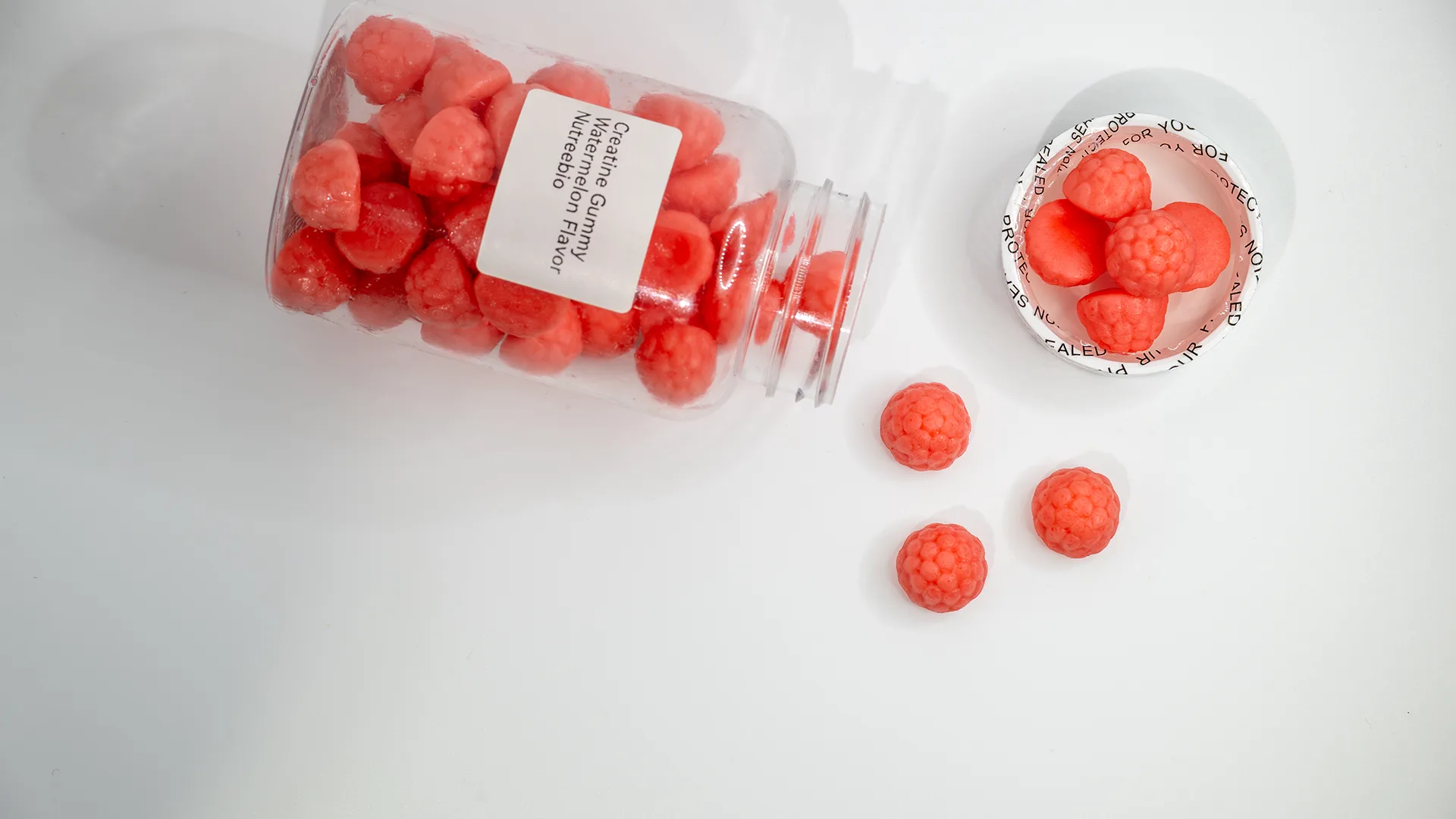
Our current creatine gummy system is designed around a real high-dose target. In a standard format, around four gummies can provide 5 g of creatine per serving. If we use a larger 5 g gummy, around three gummies can provide 5 g of creatine.
Once the dosage problem is solved, another question quickly appears:
How do we keep high-dose creatine gummies from becoming sticky or soft?
This article is based on these two real customer projects and explains what we learned from them.
1. Why Do Creatine Gummies Get Sticky?
When a customer sees sticky gummies, the first reaction is often very simple:
“Maybe they need to be dried longer.”
Sometimes that is part of the solution, but it is rarely the whole answer. Creatine gummies are more difficult to formulate than many ordinary vitamin gummies because the active ingredient level is much higher. When a large amount of creatine takes up part of the gummy formula, there is less room to adjust the other ingredients that control texture, moisture and overall stability. (If you want to learn more about creatine dosage, testing, taste and the overall manufacturing process, see our complete guide to creatine gummies.)
This means the final condition of the gummy may be affected by several factors at the same time:
- creatine loading
- gummy base formulation
- drying level
- final moisture
- storage temperature
- humidity
- packaging
- shipping conditions
So when a customer tells us that the gummies are slightly sticky or become softer after storage, we cannot only look at drying time. We need to look at the whole product. That was exactly what happened with one of our UK customers.
2. Can We Just Dry Creatine Gummies for Longer?
After one round of samples, the UK customer asked us:
“Can you make it drier?”
The answer was yes. We could adjust the drying process.
But simply making the gummies as dry as possible is not necessarily the best solution. If the drying time is increased too much, other changes may appear. The individual gummy weight can decrease because more water is removed. The texture may become harder. The flavor and eating experience may also change. This is especially important for high-dose creatine gummies.
The customer usually wants several things at the same time:
- high creatine content
- dry surface
- soft and pleasant texture
- stable piece weight
- good flavor
- good stability during storage
These requirements need to be balanced.
For us, the goal is therefore not to make a creatine gummy as dry as possible. The goal is to find a suitable balance between surface dryness, texture, weight and stability. This is why sample development is important. A gummy can look good when it first leaves the factory, but that does not automatically mean it will remain in the same condition after several months of storage or long-distance shipping.
3. What Makes Sticky Gummies Worse During Storage?
Another important point is that sticky gummies are not always caused by one production problem. The storage environment also matters.
A gummy may have a good surface condition immediately after production, but temperature and humidity can gradually change its texture. This becomes more important when products are shipped internationally. For example, a creatine gummy produced in China may later be transported to the UK, the UAE or the US. During this process, it can experience different temperatures and humidity levels. For a product that is already sensitive to moisture, the package must help protect the condition that was achieved during production.
This is where the second customer project became very useful.
4. Does Gummy Packaging Affect Stickiness?
The UAE customer preferred a tin box for the creatine gummies.
From a branding perspective, this made sense. A metal tin can look more premium and can help create a different product image compared with a normal plastic bottle.
But there was another question we had to discuss with the customer:
Does the package actually protect the gummy from moisture?
A tin box itself does not automatically solve the moisture problem. If the gummies are placed directly inside the tin without an additional sealed inner package or suitable moisture protection, the gummies can still be exposed to the air inside the container. For a moisture-sensitive product such as a high-dose creatine gummy, that can create more challenges during long-term storage. So packaging should not only be selected because it looks good.
It is also part of product stability.

5. Which Packaging Is Better for Creatine Gummies?
There is no single package that is always best for every creatine gummy.
The right choice depends on the formulation, market, transportation conditions and brand positioning. For example, a PET bottle is widely used for gummies because it is practical and easy to handle. A pouch can also provide good protection if the film structure and sealing are suitable. A tin box may give the product a more premium appearance, but if the customer wants to use this type of packaging, we may need to consider additional protection inside the tin.
Possible solutions include:
- an inner sealed pouch
- improved moisture protection
- a suitable desiccant system where appropriate
- another inner barrier structure
- changing to a bottle or pouch if the original packaging is not suitable
The important point is that the packaging decision should not be separated from the formulation.
If a customer says, “I want this package,” we also need to ask whether that package is suitable for the actual product.
6. Can Creatine Gummies Be High-Dose, Soft and Completely Dry at the Same Time?
This is one of the most important questions in creatine gummy development.
In theory, customers want everything: high creatine content, good flavor, soft texture, dry surface and strong shelf stability.
These goals are reasonable. But as the creatine loading becomes higher, the formulation window becomes narrower. If we change one part of the system, it may affect another part.
For example:
Making the gummy drier may improve the surface condition, but it may also make the texture harder.
Making the gummy softer may improve the eating experience, but moisture control can become more important.
Using a special package may improve the brand appearance, but the moisture barrier may be different from a conventional gummy package.
So when we develop high-dose creatine gummies, we usually need to understand which requirements are the most important to the customer.
This does not mean the requirements cannot be achieved. It means that formulation, drying, packaging and storage need to be considered together.
7. What Should Brands Check Before Approving a Creatine Gummy Sample?
When a brand receives a sample, it is easy to focus only on the first impression.
Does it taste good?
Does it look good?
Is the texture soft enough?
These questions are important, but for a commercial order, we suggest looking at several additional points.
Brands should also consider:
- creatine content per serving
- number of gummies per serving
- gummy weight
- surface dryness
- texture after storage
- packaging format
- expected shipping conditions
- long-term product stability
A sample that looks perfect on the first day is only the beginning.
The real question is whether the product can still meet expectations after production, packing, transportation and storage.
This is especially important for creatine gummies because high active loading makes formulation and moisture control more challenging than with many standard vitamin gummies.
8. Why We Do Not Simply Say Yes to Every Requirement
These two customer projects reminded us of something important.
A customer normally tells us the final result they want.
For example:
“I want the gummy to be drier.”
“I want 5 g of creatine per serving.”
“I want a soft texture.”
“I want to use a tin box.”
Our job is not only to say whether each request is possible individually.
We also need to understand what happens when all these requirements are put together.
If there is a conflict between product characteristics and customer expectations, it is better to discuss the risk during the development stage rather than explain the problem after mass production.
Sometimes the solution is a formula adjustment.
Sometimes it is a drying adjustment.
Sometimes it is not the gummy formula at all. The better solution may be changing the package or adding an inner moisture barrier.
That is why a creatine gummy project should be treated as a complete product system rather than simply a formula.
9. Final Thoughts
Sticky gummies may look like a small appearance problem, but with high-dose creatine gummies, the real cause can involve formulation, drying, moisture, packaging, shipping and storage at the same time.
Our experience with the UK and UAE customers showed that making the gummy “drier” is not always the complete answer. The better goal is to find the right balance between creatine dosage, texture, surface condition and long-term stability.
The customer sees one gummy.
We need to think about the whole product.
That is ultimately what matters when a creatine gummy moves from a sample on the desk to a commercial product in the market.