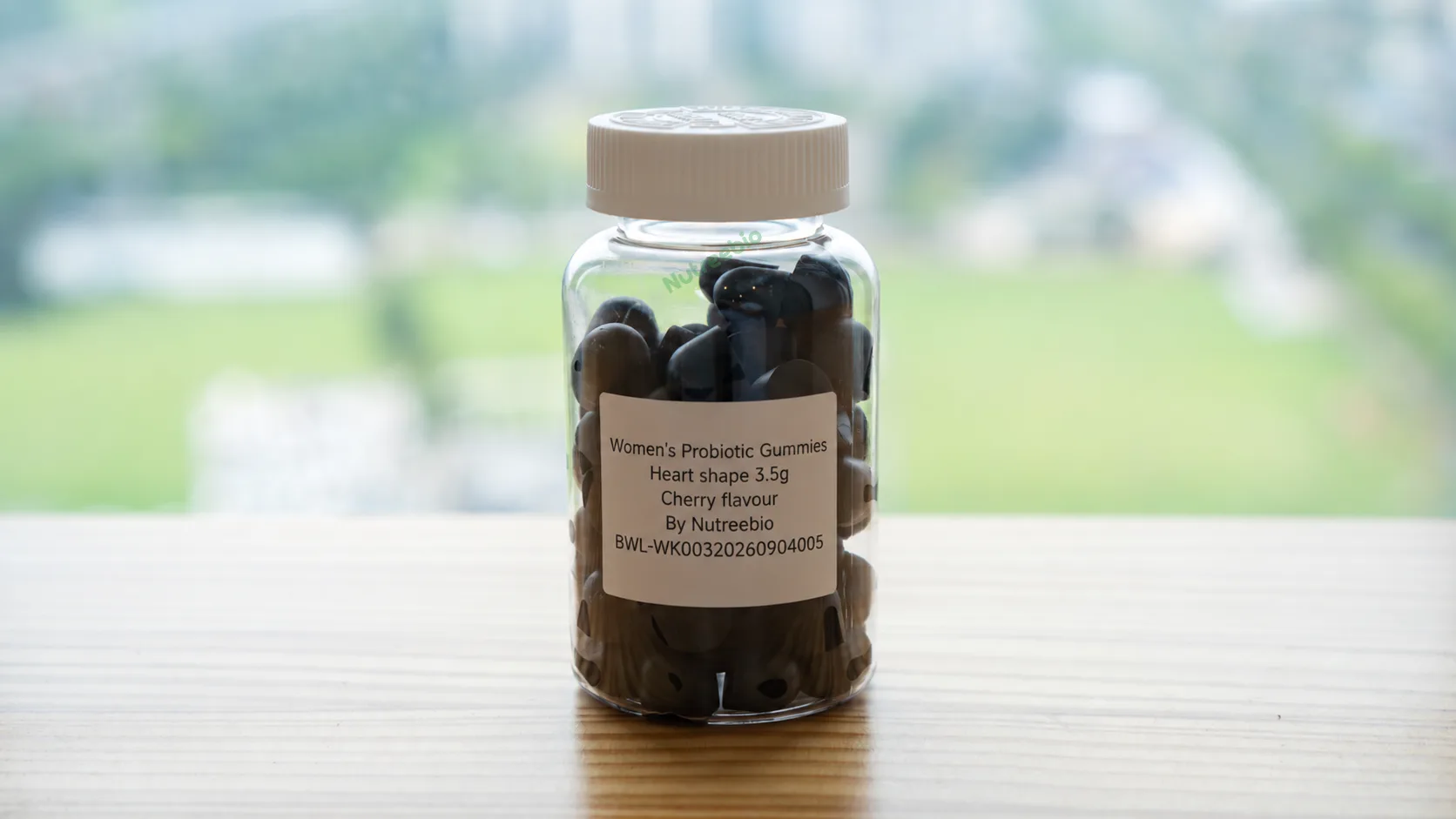
This article is based on a real product development project with one of our customers. Recently, we worked with a startup women's health brand that wanted to develop probiotic gummies for women.
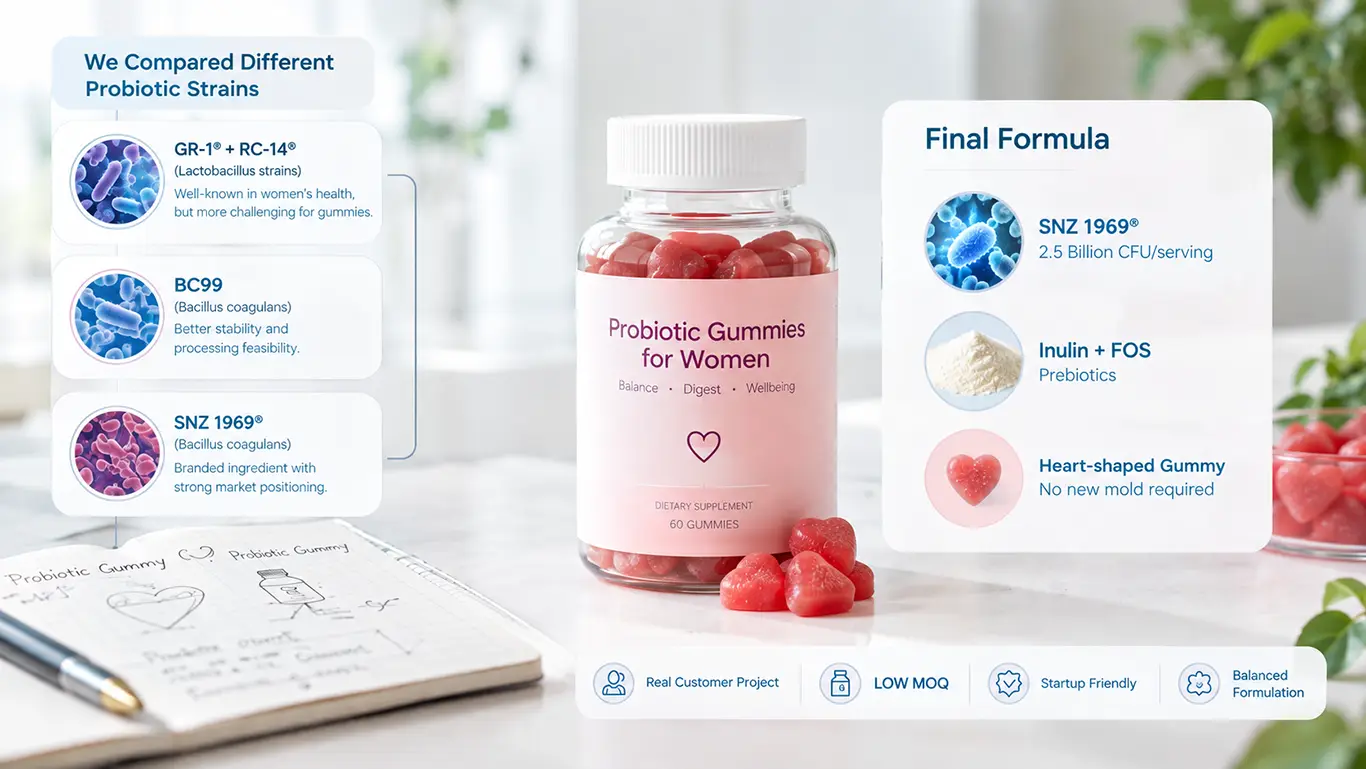
The customer already had a fairly clear product idea. They wanted the gummy to focus on women's intimate flora balance and urinary health, and they were interested in using well-known probiotic strains such as Lactobacillus rhamnosus GR-1® and Lactobacillus reuteri RC-14®.
At first, it sounded like a straightforward project.
However, once we started discussing the formula with our R&D team, the main question became more complicated:
Are all probiotic strains suitable for gummies?
The short answer is no. A strain may be well known in the supplement market, but that does not automatically mean it is the easiest choice for a gummy formula.
1. Can Probiotics Be Made Into Gummies?
Yes, probiotics can be made into gummies, but the strain selection needs to be considered carefully.
Unlike vitamins or minerals, probiotics are living microorganisms. During gummy production and storage, factors such as temperature, acidity, water activity and shelf life may affect probiotic stability.
This means that when developing women's probiotic gummies, we cannot look only at the CFU number or the marketing value of a strain.
We also need to ask:
- Can the strain tolerate the gummy production process?
- How stable will it be during the product shelf life?
- Is the raw material commercially available at the required MOQ?
- Does the ingredient fit the customer's target product cost?
These questions became especially important in this project because the customer was still at an early stage as a brand and was sensitive to both MOQ and development cost.
2. Why Were GR-1® and RC-14® More Difficult for This Project?
The customer initially preferred GR-1® and RC-14® because these strains were already known in the women's health market.
From a marketing point of view, this made sense.
The challenge was that GR-1® and RC-14® are non-spore-forming Lactobacillus strains. For a gummy product, we therefore needed to pay more attention to production temperature, acidity, moisture conditions and long-term stability.
This did not mean that we simply told the customer, "These strains cannot be used."
Instead, we explained the technical concerns and discussed whether another probiotic system might be more practical for the product.
There was also a commercial issue.
Branded probiotic raw materials can come with higher purchasing requirements. For a startup brand that does not want to begin with a very large production volume, the ingredient MOQ can sometimes become just as important as the formulation itself.
So the project was no longer only about choosing a probiotic strain.
We needed to balance product stability, brand positioning, MOQ and cost.
3. Are Spore-Forming Probiotics More Suitable for Gummies?
One option we discussed with the customer was using a spore-forming probiotic such as Bacillus coagulans BC99.
Compared with non-spore-forming Lactobacillus strains, spore-forming probiotics generally offer better processing and storage stability, which can make them more practical when evaluating probiotic gummy formulations.
For the customer, this could reduce some of the technical risk during product development.
But the customer also cared about the marketing side of the product.
During further discussions, they found that some competing products were using the branded probiotic strain SNZ 1969®. Because of this, they became interested in keeping the marketing value of a branded probiotic while still using a strain that was more suitable for the gummy format.
So we moved on to comparing several possible solutions.
4. What Probiotic Gummy Options Did We Propose?
Instead of giving the customer only one formula, we discussed three different directions.
Option 1: A Mixed Probiotic System
The first option was to combine conventional probiotic strains with a spore-forming probiotic.
The idea was to keep part of the customer's original probiotic concept while reducing some of the MOQ and cost pressure during the early stage of the brand.
We would also need to consider probiotic overage to help account for losses during production and storage.
Option 2: Use Only a Spore-Forming Probiotic
The second option was to use a probiotic that was more suitable for gummy production, such as Bacillus coagulans BC99.
This was the more straightforward option from a manufacturing point of view.
It offered better production feasibility and stability and could reduce technical risk during development.
For a customer whose main priority is getting a stable probiotic gummy to market with fewer formulation complications, this type of solution can be practical.
Option 3: Use the Branded Probiotic SNZ 1969®
The third option was to use SNZ 1969®.
This direction gave the customer two things they wanted at the same time.
First, the probiotic was suitable for further evaluation in a gummy format.
Second, it gave the product a branded probiotic ingredient that could support the customer's product positioning.
After comparing the strain characteristics, production feasibility, supply conditions and product positioning, the customer preferred this direction.
5. What Formula Did the Customer Finally Choose?
The final formula direction was:
SNZ 1969® — 2.5 Billion CFU per serving
We also added Inulin and FOS as prebiotic ingredients.
This gave the customer a probiotic and prebiotic combination that matched the product concept they wanted to build.
The formula was only one part of the project, however.
The customer also wanted a heart-shaped gummy. Fortunately, our factory already had a suitable heart-shaped mold, so there was no need to develop a new mold at the beginning of the project.
For a startup brand, this helped avoid an unnecessary development cost.
We also coordinated with the probiotic raw material supplier and were able to confirm the project MOQ at 2,000 bottles.
This gave the customer a more realistic starting quantity for initial market testing.
6. So, Which Probiotic Strain Is Best for Probiotic Gummies for Women?
There is no single probiotic strain that is best for every project.
If production stability and lower technical risk are the main priorities, a spore-forming probiotic may be worth considering.
If the brand wants to use a specific well-known Lactobacillus strain, the gummy production conditions, stability and raw material supply requirements need to be evaluated more carefully.
If branded ingredients are important for marketing, then the brand also needs to consider whether the ingredient MOQ and cost match the current stage of the business.
For this customer, SNZ 1969® provided a better balance between gummy production feasibility and branded ingredient positioning.
But another customer may make a different choice.
That is why we normally prefer to compare several realistic options rather than simply saying that one probiotic strain is always the best.
7. What Should a Startup Brand Consider Before Developing Women's Probiotic Gummies?
For a new brand, the most complicated formula is not always the best starting point.
Before developing probiotic gummies for women, it is useful to define a few things clearly:
the target probiotic strain, CFU per serving, desired product positioning, acceptable MOQ, target cost and preferred gummy format.
Once these points are clear, it becomes much easier to compare different probiotic systems and decide which one makes sense commercially as well as technically.
This project was a good example.
The customer started with a specific idea around GR-1® and RC-14®, but after discussing the actual production conditions, raw material requirements and market positioning, the formula changed.
The final result was not simply the formula that looked best on paper. It was the one that better matched the customer's current stage as a startup brand and allowed the project to move from an idea into sample preparation.