One question we hear regularly from supplement brands is: "Can you make a gummy containing 50 mg, 70 mg, or even 100 mg of elemental magnesium?"
It sounds simple, especially when some magnesium gummies on the market already advertise these amounts. But from a manufacturing perspective, achieving a high magnesium dosage while maintaining a pleasant gummy texture is far more complicated than it appears.
At Nutreebio, we've worked on magnesium gummy formulations for daily wellness, relaxation, and sleep-support product concepts. Many customers want a relatively small gummy with a substantial magnesium dosage, preferably using magnesium citrate or magnesium glycinate.
The difficulty is that magnesium compounds occupy a significant proportion of the formulation and can interfere with the gummy's gel structure. In conventional pectin systems, increasing magnesium loading often results in gummies that are too soft, grainy, or difficult to mold consistently. To address this, our R&D team has been working with blended gelling systems that combine pectin, carrageenan, and agar. This approach has allowed us to develop selected formulations delivering 50–70 mg of elemental magnesium in a 3 g gummy, and up to 100 mg in a 5 g gummy. We have also applied blended gelling technology beyond laboratory sampling in commercial production. However, the higher magnesium content comes with trade-offs. Texture, sweetness, appearance, and processing conditions all need adjustment.
In this article, we'll explain how blended gelling systems work, share two magnesium gummy development cases, and discuss what supplement brands should consider before choosing a high-dose formulation.
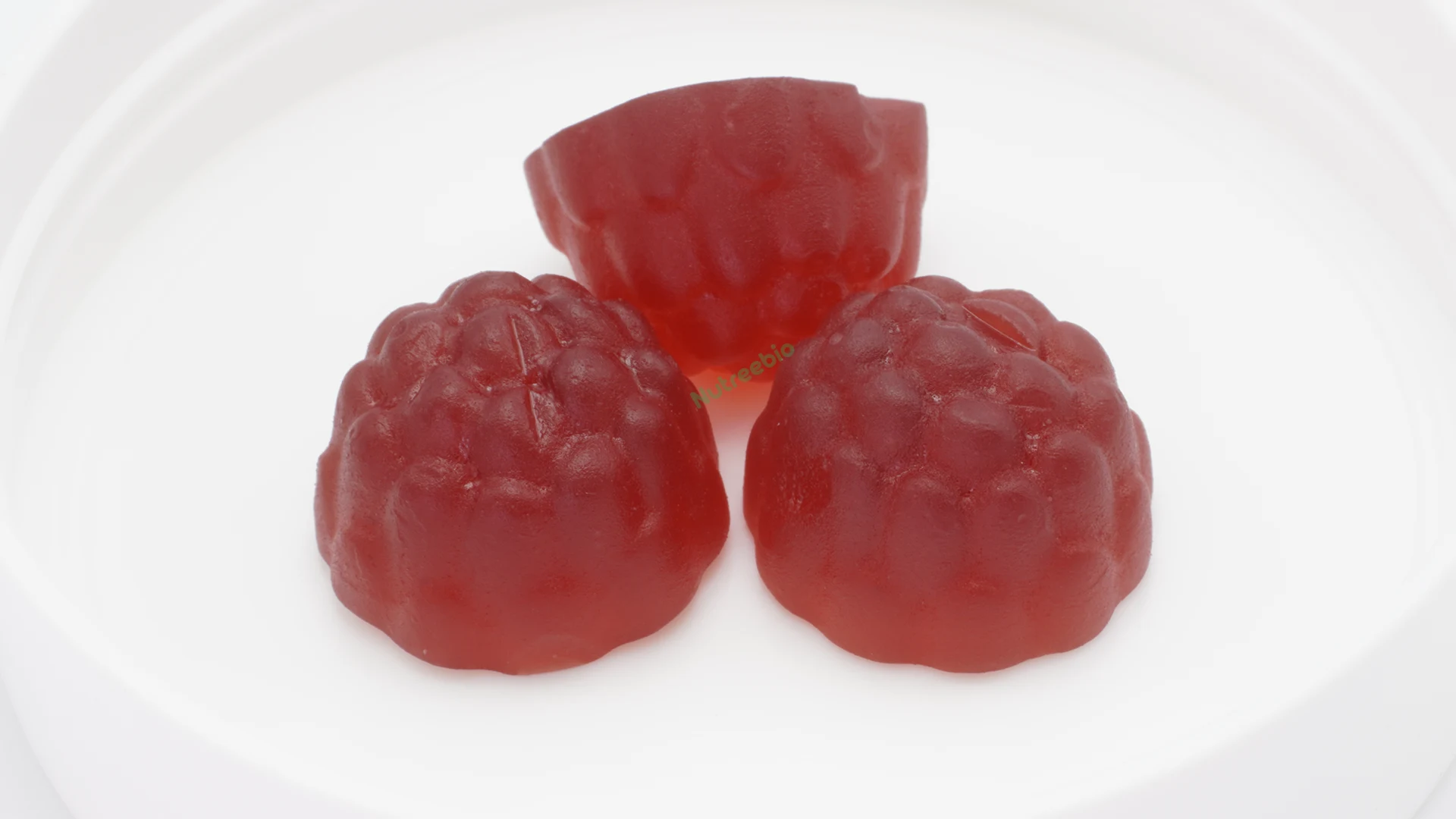
1. Why Are High-Dose Magnesium Gummies Difficult to Manufacture?
The main challenge with high-dose magnesium gummies is not simply the amount of magnesium added, but how magnesium compounds affect the gummy's structure, texture, and processing behavior.
Unlike many vitamins that require only a few milligrams per serving, magnesium is often formulated at substantially higher doses.
Furthermore, the magnesium compounds used in manufacturing contain only a proportion of elemental magnesium. For example, magnesium citrate generally provides approximately 14–16% elemental magnesium, depending on the raw material specification. This means that a formulation targeting 100 mg of elemental magnesium may require roughly 650–700 mg of magnesium citrate.
For a standard 3 g gummy, that represents a considerable amount of raw material.
1.1 How Magnesium Affects Conventional Pectin Gummies
Many conventional pectin gummies rely on high-methoxyl pectin, which typically requires a suitable balance of acidity and soluble solids to achieve the desired gel structure. High levels of mineral ingredients can change the formulation's pH, ionic environment, and physical properties.
As magnesium compounds are added, our laboratory has observed several challenges:
- Weak gel formation: Gummies may become too soft or fail to maintain their intended shape.
- Reduced elasticity: The familiar springy texture becomes more difficult to achieve.
- Grainy mouthfeel: Higher mineral loading can make the gummy feel powdery or chalky.
- Flavor imbalance: Magnesium ingredients may introduce bitterness or other undesirable taste characteristics.
- Processing difficulties: Changes in viscosity and gelation behavior can affect cooking and depositing.
These effects depend on the magnesium compound, gelling system, formulation, and processing conditions. They are not identical for every type of pectin.
Low-methoxyl pectin, for example, has different gelation mechanisms from conventional high-methoxyl pectin.
In our experience, however, simply increasing the amount of magnesium compound in a conventional gummy formulation rarely gives satisfactory results.
For some of our earlier 3 g pectin gummy trials, practical magnesium compound addition was approximately 50–100 mg per piece, corresponding to only around 7–15 mg of elemental magnesium, depending on the compound. That amount can be suitable for certain multi-ingredient gummies, but it may not meet the requirements of brands developing a magnesium-focused supplement.
This is why we began exploring alternative gelling systems. For a closer look at elemental magnesium calculations and dosage limitations, read our Magnesium Gummies Dosage Explained guide.
2. How Do Blended Gelling Systems Help Increase Magnesium Loading?
A blended gelling system combines different gelling agents to create a structure that can be adjusted for higher mineral loading. Instead of relying on a single gelling mechanism, the formulation uses the complementary properties of multiple hydrocolloids.
At Nutreebio, one of the approaches developed by our laboratory combines three plant-derived gelling agents:
- Pectin
- Carrageenan
- Agar
Each ingredient contributes different functional properties.
2.1 Pectin: Structure and Gummy Texture
Pectin is widely used in vegan gummies because it can create a pleasant bite and a relatively clean mouthfeel.
However, its behavior depends on the specific pectin grade, acidity, soluble solids, and mineral environment.
For magnesium gummies, these factors need careful adjustment because increasing the magnesium compound concentration can change how the gel develops.
2.2 Carrageenan: Additional Gel Structure
Carrageenan is another plant-derived hydrocolloid, obtained from red seaweed.
Different carrageenan types have different gelling properties and responses to mineral ions. When used appropriately in a blended system, carrageenan can help modify gel firmness, elasticity, and structural characteristics.
It is important to select the correct grade and proportion. Adding carrageenan does not automatically make a gummy stronger or more stable.
2.3 Agar: Supporting Gel Formation
Agar is also derived from red seaweed and is known for its ability to form gels through cooling.
Its gelling behavior differs from conventional high-methoxyl pectin systems. When combined with other gelling agents, agar can contribute to the final structure and help formulators explore different texture profiles.
However, agar can produce a relatively firm or brittle gel when used alone, so its proportion must be carefully controlled.
2.4 Why We Combine These Three Ingredients
Our objective was not simply to make a harder gummy.
We needed a formulation that could accommodate a higher proportion of magnesium compounds while remaining suitable for manufacturing, molding, handling, and packaging.
By adjusting the combination of pectin, carrageenan, and agar, our laboratory was able to develop gummy structures with greater flexibility for selected high-magnesium formulations. This required several adjustments to ingredient proportions and processing conditions.
The resulting gummies do not necessarily have the same elasticity, transparency, or smooth texture as ordinary low-dose vitamin gummies. However, they provide a practical alternative for brands that prioritize elemental magnesium content over a traditional candy-like texture.
We do not use one fixed blended-gel formula for every magnesium gummy project. The gelling system must be adjusted according to the magnesium source, dosage, gummy weight, sweetener system, and other active ingredients.

3. How Much Elemental Magnesium Can We Add to Gummies?
One of the most important lessons from our magnesium gummy development work is that gummy weight and gelling system must be considered together when setting the target dosage.
A larger gummy provides more physical space for the magnesium compound and other ingredients. However, size alone does not guarantee successful manufacturing.
Our recent R&D experience has established the following formulation capabilities for selected blended-gel systems:
| Gummy Weight | Elemental Magnesium | Manufacturing Approach |
|---|---|---|
| 3 g | 50–70 mg | Blended gelling system |
| 5 g | Up to 100 mg | Blended gelling system |
These figures reflect our development and manufacturing experience with specific formulations. They should not be interpreted as universal limits or guaranteed results for every magnesium compound.
The amount of magnesium compound required depends on its elemental magnesium percentage, physical characteristics, and raw material specification. The final labelled magnesium content also needs to be supported by appropriate calculations, production records, and finished-product testing.
3.1 Why Gummy Weight Matters
Consider two possible product concepts.
Option A: Two 3 g Gummies
A serving of two 3 g gummies could be developed to target approximately 100 mg of elemental magnesium, using a suitable blended-gel formulation.
This gives the brand a relatively familiar serving format while providing a meaningful magnesium quantity.
Option B: Two 5 g Gummies
With two 5 g gummies, the formulation has more room for magnesium compounds and other ingredients.
A selected formulation may target 200 mg of elemental magnesium per two-gummy serving. However, the larger size and higher mineral loading can change the eating experience.
Brands should also consider whether the intended serving size is convenient for consumers and appropriate for the target market.
At Nutreebio, we normally discuss the target elemental magnesium dosage and serving size together before finalizing the formulation.
A 3 g gummy targeting 100 mg of elemental magnesium presents a different manufacturing challenge from a 5 g gummy targeting the same amount.
4. Two Real Factory Trials: High-Magnesium vs. Multi-Ingredient Gummies
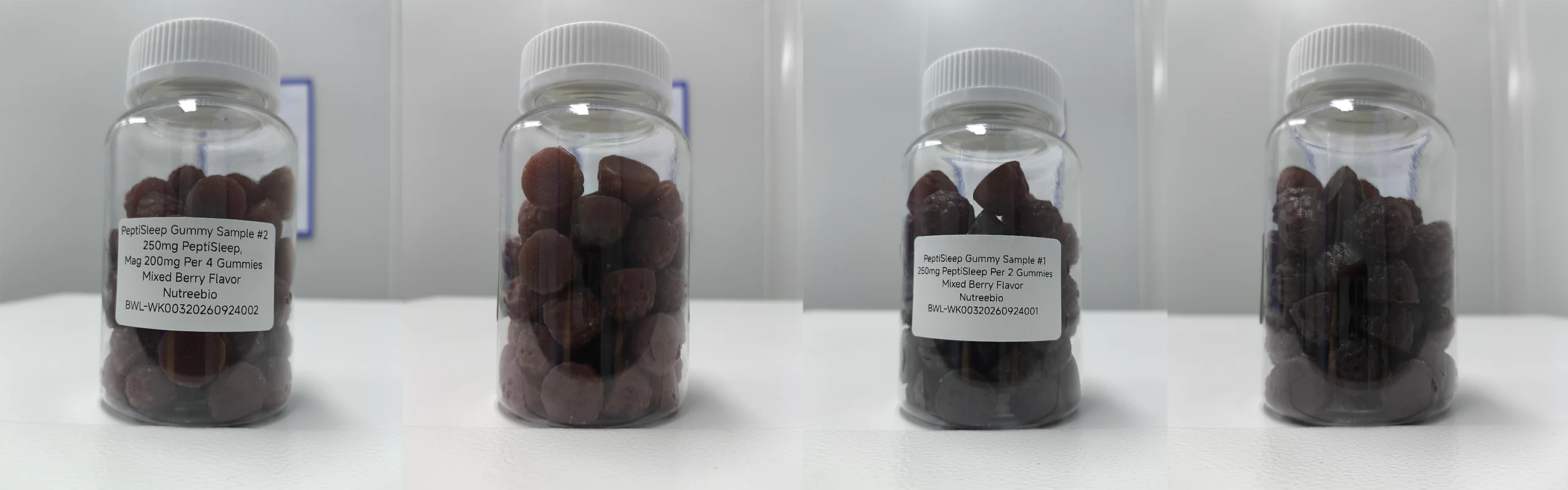
In October 2026, our team worked on two magnesium-based gummy formulations for an Australian customer interested in sleep-support and relaxation products. Both projects involved magnesium citrate, but the formulation strategies were different.
The first emphasized higher magnesium loading alongside a branded peptide ingredient.
The second used a lower magnesium compound concentration, allowing room for L-theanine and several botanical extracts.
We prepared samples and collected customer feedback on their texture, sweetness, and flavor. These projects provide a useful comparison of the compromises involved in magnesium gummy development.
4.1 Formula A: Magnesium Citrate + PeptiSleep™
The first formulation combined magnesium citrate with PeptiSleep™, a branded plant-derived peptide ingredient obtained from brown rice protein hydrolysate.
The initial sample composition included:
| Active Ingredient | Amount per Gummy |
|---|---|
| Magnesium Citrate | 350 mg |
| PeptiSleep™ | 62.5 mg |
Magnesium citrate is shown as compound weight, not elemental magnesium.
This formulation placed a relatively high magnesium compound load into the gummy. During development, we needed to balance the mineral ingredients with the gelling system to achieve an acceptable structure.
The customer was generally satisfied with the sample, but their feedback also highlighted several texture differences compared with ordinary vitamin gummies.
Texture: The gummy was relatively soft and slightly loose in structure. It was not as firm or smooth as a typical low-dose vitamin gummy.
Sweetness: The high concentration of active ingredients affected the overall flavor balance, making the sweetness less noticeable.
Stickiness: The customer also observed a somewhat stickier texture, which required further attention during formulation development.
Our laboratory considered the high magnesium concentration and the peptide-containing ingredient system when reviewing these issues. With high active loading, even relatively small adjustments to the gummy base can influence the final texture. In this case, we considered adjustments to the sweetener system and gelling formulation rather than simply adding more flavoring.
High-intensity sweeteners, such as steviol glycosides or sucralose where permitted, may be considered to rebalance sweetness, depending on the target market and formulation requirements. The important point is that a higher magnesium dosage affects more than the nutrition panel. It also changes what consumers experience when they chew the gummy.
4.2 Formula B: Magnesium + L-Theanine + Botanical Extracts
The second formulation used a different strategy. Instead of maximizing the magnesium concentration, we reduced the magnesium compound loading to create space for other active ingredients.
The sample formulation contained:
| Active Ingredient | Amount per Gummy |
|---|---|
| Magnesium Citrate | 80 mg |
| L-Theanine | 25 mg |
| Chamomile Extract (10:1) | 37.5 mg |
| Passion Flower Extract (10:1) | 37.5 mg |
| Saffron Extract (10:1) | 7 mg |
Amounts refer to the listed raw materials per gummy. The elemental magnesium value must be calculated from the actual magnesium citrate specification.
The customer's feedback was noticeably different from the first sample. They found the overall texture and sweetness more satisfactory. The gummy had a better-balanced bite and a more pleasant eating experience.
However, the flavor was not yet strong enough to fully complement the botanical ingredients. Chamomile, passion flower, and saffron extracts each contribute their own taste characteristics. When several botanical extracts are combined, their flavors can become more noticeable.
For this type of formulation, selecting the right fruit flavor is just as important as increasing flavor intensity. Our team therefore discussed adjusting the flavor system to better balance the herbal notes.
4.3 What Did We Learn from These Two Samples?
Both formulas were developed for relaxation-oriented product concepts, but their formulation priorities were different.
The first placed greater emphasis on magnesium loading.
The second prioritized combining magnesium with several complementary ingredients while maintaining a pleasant gummy texture.
The comparison illustrates a common decision facing supplement brands:
Should the product deliver a higher amount of one primary ingredient, or a moderate amount of magnesium alongside several other actives?
There is no universal answer.
The customer's product positioning, target dosage, preferred serving size, and sensory requirements all influence the decision. Customer feedback on taste and texture is useful for formulation development, but it should not be confused with clinical evidence of sleep efficacy.
In our work, these trials were primarily intended to evaluate manufacturing feasibility and product experience.
5. What Are the Main Trade-Offs in High-Dose Magnesium Gummies?
Although blended gelling systems can improve formulation flexibility, they do not eliminate every challenge associated with high mineral loading.
Our laboratory still needs to pay close attention to several factors.
5.1 Texture and Elasticity
Conventional vitamin gummies often have a smooth, elastic texture and a relatively transparent appearance.
High-magnesium gummies can behave differently.
When a substantial proportion of the formula consists of magnesium compounds, the gummy may become softer, less elastic, or more difficult to handle. The exact result depends on the mineral source, particle characteristics, gel composition, and processing conditions.
We therefore evaluate the physical structure of the gummy alongside its active ingredient content.
5.2 Graininess and Appearance
High levels of magnesium compounds can affect the appearance of the gummy.
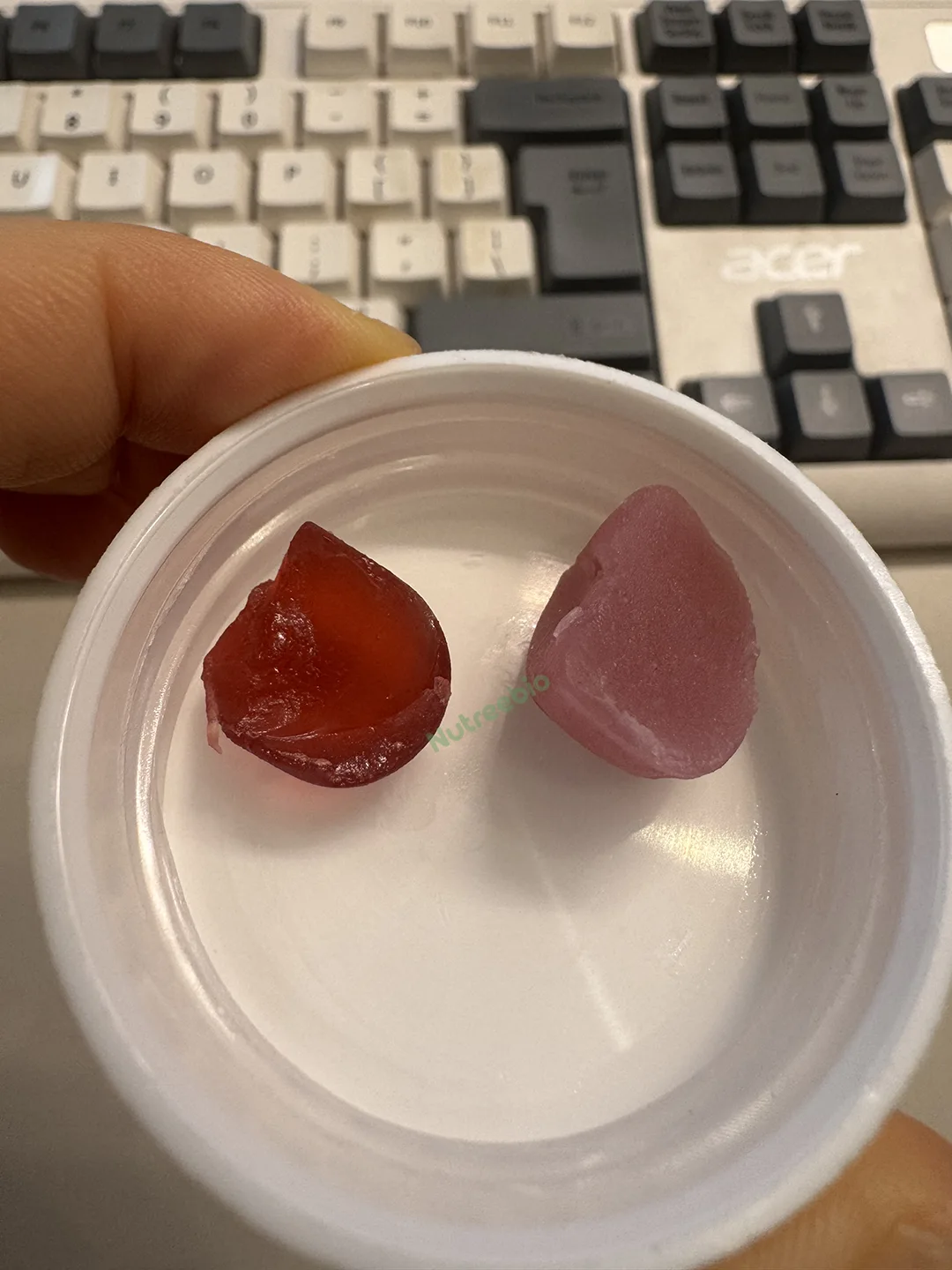
Compared with a typical transparent fruit gummy, a high-mineral formulation may look more opaque. When the gummy is cut open, fine dispersed particles may be visible within the structure. The mouthfeel can also become slightly powdery or sandy, particularly when the mineral ingredients are not adequately dispersed. This does not necessarily mean the product is unsuitable.
Some consumers may accept a different texture in exchange for a higher active ingredient dosage. However, brands should understand these characteristics before approving a commercial formulation.
5.3 Sweetness and Flavor Masking
Magnesium compounds can influence the perceived sweetness and flavor balance of a gummy. As the active ingredient concentration increases, fruit flavors may become less prominent and undesirable mineral notes may become more noticeable.
One approach we use is to improve the particle characteristics of suitable magnesium raw materials through fine grinding or other appropriate material preparation. Finer particles may help reduce noticeable graininess and improve distribution within the gummy mixture. However, particle size reduction cannot solve every taste or solubility problem.
Sweetener selection is another important consideration. Depending on the product requirements, the formulation may combine bulk sweeteners with carefully controlled quantities of high-intensity sweeteners. The goal is to achieve a balanced flavor without creating excessive sweetness or unpleasant aftertaste.
5.4 Processing and Stability
Cooking and depositing conditions also influence the final gummy quality.
Changes in temperature, processing time, acidity, and the timing of active ingredient addition can affect the gelling process. These variables become particularly important when the formulation contains substantial mineral loading.
At Nutreebio, we adjust processing conditions according to the specific formula rather than treating all gummies as interchangeable products. A suitable laboratory sample is the starting point. Consistent production also requires attention to batch control, drying or conditioning where applicable, packaging, and storage stability.
6. High-Magnesium or Multi-Ingredient Gummies: Which Should Brands Choose?
When developing magnesium gummies, some customers want magnesium to be the main selling point.
Others prefer to combine magnesium with L-theanine, botanical extracts, or other ingredients in a broader wellness formulation.
Both directions are possible, but they require different formulation priorities.
| Feature | High-Magnesium Gummies | Multi-Ingredient Gummies |
|---|---|---|
| Main Objective | Prioritize elemental magnesium dosage | Combine magnesium with other active ingredients |
| Magnesium Loading | Higher | Usually lower to leave room for other actives |
| Formulation Space | More limited | Shared among several ingredients |
| Texture Challenges | Greater risk of graininess or weak gel structure | Depends on total loading and ingredient compatibility |
| Flavor Challenges | Mineral notes and reduced sweetness | Mineral and botanical flavors |
| Product Positioning | Magnesium-focused supplement | Broader wellness or relaxation concept |
For brands emphasizing magnesium content, we may recommend a relatively simple formula with fewer additional active ingredients.
For example, a two-gummy serving containing 100 mg of elemental magnesium may be a suitable development target for a magnesium-focused product.
If the brand wants to add substantial quantities of L-theanine or botanical extracts, it may be more practical to reduce the magnesium concentration. This provides more room for the additional ingredients and can make it easier to maintain an acceptable gummy texture. The correct balance must be established through formulation trials.
Adding more ingredients does not automatically create a better product.
A well-designed gummy should deliver its intended active ingredients while remaining practical to manufacture and pleasant to consume.
7. What Should Be Verified Before Commercial Production?
A higher elemental magnesium target is meaningful only when the finished product can meet its specifications consistently.
Before commercial production, we recommend evaluating the following areas.
Elemental Magnesium Content
The formulation should distinguish between magnesium compound weight and elemental magnesium.
Raw material specifications must be checked, and the finished product's declared magnesium content should be supported by appropriate verification.
Gel Structure and Texture
Samples should be assessed for firmness, elasticity, appearance, graininess, and handling performance.
A gummy that looks acceptable immediately after production should also maintain suitable physical characteristics during its intended shelf life.
Flavor and Consumer Experience
High-magnesium formulations may require several rounds of flavor adjustment.
The product should be evaluated for sweetness, mineral aftertaste, botanical notes where applicable, and overall chewability.
Manufacturing Consistency
The process should be capable of producing gummies with consistent weight, active ingredient distribution, and physical characteristics.
Appropriate production controls and analytical testing are important, particularly when brands intend to make specific magnesium content claims.
Packaging and Stability
Packaging should be selected according to the formulation's moisture sensitivity and intended storage conditions.
A high-active gummy may behave differently from a conventional vitamin gummy, making product-specific stability evaluation important.
These considerations are especially relevant when moving from a successful R&D sample to repeated commercial production.
8. Final Thoughts: Higher Magnesium Is Possible, but Formulation Still Matters
High-dose magnesium gummies are no longer limited to conventional single-pectin formulations. By developing blended gelling systems using pectin, carrageenan, and agar, we have been able to increase magnesium loading in selected gummy formulations while maintaining workable product structures.
Our experience shows that formulations targeting 50–70 mg elemental magnesium in a 3 g gummy, or 100 mg in a 5 g gummy, can be technically achievable.
However, the higher dosage brings real formulation compromises. Texture may become softer, the gummy may appear less transparent, and mineral ingredients can introduce graininess or undesirable flavor notes. Our two recent magnesium gummy trials also demonstrate that a high-magnesium formulation and a multi-ingredient relaxation formulation require different development strategies.
At Nutreebio, we believe the most practical approach is to establish the target elemental magnesium content, gummy weight, and desired consumer experience before finalizing the formulation.
As a dietary supplement manufacturer, we work with brands to develop customized gummies that balance active ingredient loading, texture, flavor, and manufacturing feasibility.
For brands considering high-dose magnesium gummies, the goal should not simply be to put as much magnesium as possible into one gummy. It should be to develop a formula that can be manufactured consistently, meets its intended specifications, and offers an acceptable eating experience.